Parcel management software may look simple from the outside: a package arrives, staff logs it, the resident receives a notification, and the parcel is collected. But behind that workflow is a backend system that needs to handle structured parcel data, real-time notifications, user permissions, audit logs, third-party integrations, and high-volume search.
In residential buildings, student housing communities, coworking spaces, and mixed-use properties, parcel volume can quickly become an operational bottleneck. Manual logging may work when a building receives only a few packages per day. But once daily volume reaches dozens or hundreds of deliveries, parcel handling becomes less of a front-desk task and more of a back-end workflow challenge.
The operational case is clear: manual parcel workflows consume staff time, lead to repeated resident inquiries, increase the risk of misplaced items, and complicate dispute resolution. The original business case for parcel management software highlights how digital logging, automated notifications, searchable records, and pickup verification can reduce staff workload and improve resident experience.
From a technical perspective, the question becomes: how should a parcel management platform be designed to support automation, integrations, auditability, and scalability?
Core Components of a Parcel Management Platform
A modern parcel management platform is not just a digital spreadsheet. It is usually composed of several interconnected backend components that manage the full parcel lifecycle.
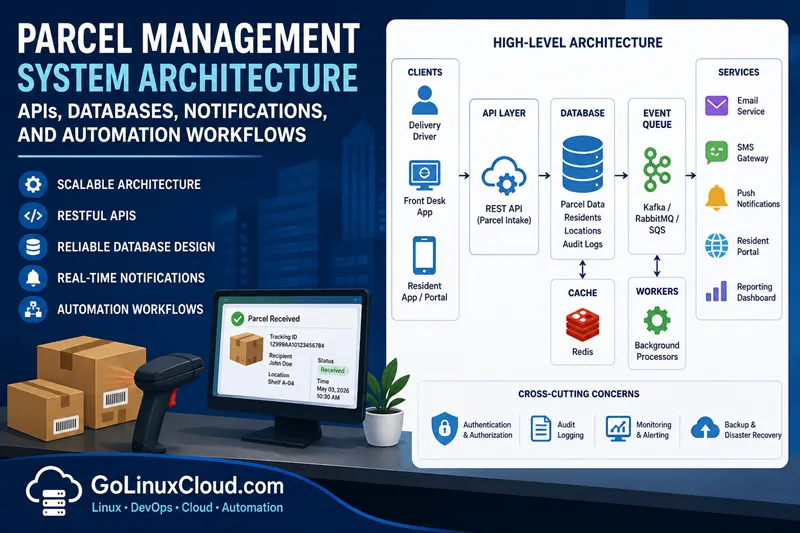
At a high level, the architecture may look like this:
Carrier / Delivery Driver
        |
        v
Front Desk Scanner / App
        |
        v
Parcel Intake API
        |
        v
Database  ---> Audit Logs
        |
        v
Event Queue / Worker
        |
        +--> Email
        +--> SMS
        +--> Push Notifications
        +--> Resident Portal
        +--> Dashboard
Each layer has a specific role.
- The intake interface allows staff to scan a barcode, enter a tracking number, select a recipient, add notes, and assign a storage location.
- The backend API validates the parcel data, writes it to the database, applies business rules, and triggers downstream actions.
- The database stores parcel records, recipient data, staff actions, pickup status, notification history, and audit events.
- The notification system sends alerts to residents through email, SMS, push notifications, or in-app messages.
- The reporting layer gives property managers visibility into parcel volume, collection times, overdue packages, unresolved items, and operational performance.
Together, these components turn parcel handling into a structured, traceable workflow.
Designing the Parcel Intake Workflow
The parcel intake workflow is the system's starting point. This is where a physical package becomes a digital record.
A basic intake flow may look like this:
- Staff scans the barcode or enters the package details.
- System identifies the recipient.
- Staff confirms the delivery information.
- System creates a parcel record.
- Storage location is assigned.
- Resident notification is triggered.
- Audit event is written.
In backend terms, this is more than a simple INSERT operation. The system may need to validate the recipient, verify that the resident is active, prevent duplicate records, normalize carrier data, and determine which notification channel to use.
A simplified API request might look like this:
POST /api/parcels
Content-Type: application/json
Authorization: Bearer <token>

{
  "tracking_number": "9505510041018320003872",
  "courier": "USPS",
  "recipient_id": "res_12345",
  "storage_location": "Shelf A-04",
  "size": "medium",
  "notes": "Fragile item"
}
The response could return the newly created parcel record:
{
  "parcel_id": "par_98765",
  "status": "received",
  "recipient_id": "res_12345",
  "storage_location": "Shelf A-04",
  "logged_in_at": "2026-04-30T09:15:00Z",
  "notification_status": "queued"
}
For integrations, platforms may expose public APIs that allow external systems to retrieve parcel records or synchronize parcel data.
Parcel Tracker's developer documentation, for example, describes an external-facing API that uses API-key authentication and supports parcel retrieval with filters such as development ID, logged-in timestamp, updated timestamp, recipient external ID, recipient email, page, and page size. ... page size. (Parcel Tracker Open API)
A Parcel Tracker-style request may look like this:
GET /api/v2/public/parcels?development_id=1&page=1&page_size=10
Authorization: ApiKey <apikey>
This kind of API design is important when parcel data needs to be connected with property management systems, resident portals, business intelligence dashboards, or internal operational tools.
Database Design for Parcel Management
A scalable parcel platform needs a database schema that supports search, traceability, reporting, and lifecycle management. For stateful workloads like databases, it is important to understand how Kubernetes Statefulset work for persistence and scaling.
At a minimum, the system may include tables or collections such as:
- residents
- units
- buildings
- staff_users
- parcels
- storage_locations
- parcel_events
- notifications
- pickup_verifications
- audit_logs
A simplified parcel table might include:
CREATE TABLE parcels (
    id UUID PRIMARY KEY,
    tracking_number VARCHAR(255),
    barcode VARCHAR(255),
    courier VARCHAR(100),
    recipient_id UUID NOT NULL,
    building_id UUID NOT NULL,
    storage_location_id UUID,
    status VARCHAR(50) NOT NULL,
    size VARCHAR(50),
    notes TEXT,
    logged_in_at TIMESTAMP NOT NULL,
    logged_out_at TIMESTAMP,
    last_updated_at TIMESTAMP NOT NULL
);
The parcel record itself should not be the only source of truth. A separate event table helps preserve the parcel lifecycle:
CREATE TABLE parcel_events (
    id UUID PRIMARY KEY,
    parcel_id UUID NOT NULL,
    event_type VARCHAR(100) NOT NULL,
    actor_type VARCHAR(50),
    actor_id UUID,
    event_timestamp TIMESTAMP NOT NULL,
    metadata JSONB
);
Example event types may include:
- PARCEL_RECEIVED
- RECIPIENT_NOTIFIED
- REMINDER_SENT
- STORAGE_LOCATION_UPDATED
- PARCEL_COLLECTED
- PARCEL_RETURNED
- PARCEL_DISPUTED
This event-based model is useful because parcel management often requires a clear chain of custody.
If a resident claims they were not notified or a package cannot be located, the system should show when the parcel was logged, where it was stored, who handled it, when notifications were sent, and whether pickup was verified.
Relational databases like MySQL or PostgreSQL are commonly used, and understanding concepts like Foreign key in SQL helps maintain data integrity.
Event-Driven Automation Workflows
Parcel management systems are a good fit for event-driven architecture because every operational step can trigger another action. In production systems, event streaming platforms such as Laravel Kafka Tutorial or similar Kafka-based systems are commonly used to process parcel events asynchronously.
For example:
ParcelLoggedIn
    -> Save parcel record
    -> Assign storage location
    -> Create audit event
    -> Queue resident notification

ResidentNotified
    -> Record notification status
    -> Start reminder schedule

ParcelCollected
    -> Update parcel status
    -> Record pickup timestamp
    -> Cancel future reminders
    -> Create pickup verification event

ParcelOverdue
    -> Send reminder
    -> Flag parcel in dashboard
    -> Escalate to staff if needed
Instead of forcing every task to happen synchronously during intake, the backend can use queues and workers.
A typical implementation may use:
- Redis Queue
- RabbitMQ
- Apache Kafka
- AWS SQS
- Google Pub/Sub
- Azure Service Bus
For example, after a package is logged, the API can write the parcel record immediately and then publish an event:
{
  "event": "ParcelLoggedIn",
  "parcel_id": "par_98765",
  "recipient_id": "res_12345",
  "building_id": "bldg_001",
  "timestamp": "2026-04-30T09:15:00Z"
}
A background worker can consume that event and send the resident notification. This keeps the intake process fast for staff and improves reliability because failed notifications can be retried without blocking package logging. Lightweight queue systems such as Laravel Horizon or Redis-based queues are often used for handling background jobs like notifications.
Notification System Design
Notifications are one of the most important automation layers in parcel management. In manual workflows, staff may need to write emails, send texts, or answer repeated "Has my package arrived?" inquiries. Software-driven systems automate this process.
A notification system should support:
- Email alerts
- SMS alerts
- Push notifications
- In-app notifications
- Pickup reminders
- Overdue parcel alerts
- Failed delivery handling
- Notification templates
- Resident communication preferences
The notification workflow may look like this:
Parcel received
      |
      v
Notification event created
      |
      v
Check resident preferences
      |
      +--> Send email
      +--> Send SMS
      +--> Send push notification
      |
      v
Store delivery status
A backend notification table might include:
CREATE TABLE notifications (
    id UUID PRIMARY KEY,
    parcel_id UUID NOT NULL,
    recipient_id UUID NOT NULL,
    channel VARCHAR(50) NOT NULL,
    status VARCHAR(50) NOT NULL,
    sent_at TIMESTAMP,
    failed_at TIMESTAMP,
    failure_reason TEXT
);
This matters because notifications are not guaranteed to succeed. SMS providers may fail, email may bounce, and push tokens may expire. The system should record each attempt and retry where appropriate.
For high-volume buildings, notification batching may also be useful. If a resident receives five packages within a short period, the system may send one grouped alert instead of five separate messages.
API and Integration Considerations
A parcel management platform rarely operates in isolation. It usually needs to connect with other systems in the property technology stack.
Common integrations include:
- Property management systems
- Resident mobile apps
- Access control systems
- Smart lockers
- Email and SMS providers
- Business intelligence dashboards
- Identity providers
- Webhooks
For example, a property management system may be the source of truth for resident names, unit numbers, email addresses, phone numbers, move-ins, and move-outs. The parcel platform can sync that information, so staff do not need to manually maintain recipient records.
For production systems, API design should also consider:
- Authentication
- Authorization
- Rate limiting
- Input validation
- Idempotency
- Pagination
- Filtering
- Versioning
- Error responses
- Audit logging
Idempotency is especially important during parcel intake. If a scanner or client application retries a request after a timeout, the backend should avoid creating duplicate parcel records.
Example Technology Stack
A parcel management platform can be built using many different stacks. A typical cloud-native deployment may use Docker for containerization and Kubernetes Tutorial for orchestration and scaling. One possible cloud-native implementation may look like this:
| Component | Example Technologies |
|---|---|
| Backend API | Python FastAPI, Node.js, Go, Java Spring Boot |
| Database | PostgreSQL, MySQL |
| Cache | Redis |
| Queue | RabbitMQ, Redis Queue, Apache Kafka, AWS SQS |
| Object Storage | S3-compatible storage |
| Notifications | SMTP, SMS Gateway, Firebase Cloud Messaging |
| Authentication | OAuth2, JWT, API Keys, SSO |
| Containerization | Docker |
| Orchestration | Kubernetes, Amazon ECS, Linux-based VMs |
| Observability | Prometheus, Grafana, ELK Stack |
For many teams, PostgreSQL is a strong fit because parcel systems need relational data, filtering, indexing, JSON metadata, and reporting queries.
Security and Access Control
Parcel data may include resident names, addresses, phone numbers, email addresses, delivery history, and collection status. That means access control should be designed carefully. Modern APIs typically use token-based authentication, and frameworks like Laravel Authentication provide built-in support for secure API access.
A role-based access control model may include:
- Resident
- Front desk staff
- Mailroom staff
- Property manager
- Regional manager
- System administrator
- API integration user
Each role should have different permissions.
For example:
- Residents can view only their own parcels.
- Front desk staff can log and release parcels for assigned buildings.
- Property managers can view reports for their properties.
- Regional managers can view portfolio-level analytics.
- API users can access only approved endpoints and data scopes.
API keys should be stored securely, rotated periodically, and scoped where possible. Public APIs should not expose more resident information than required for the integration. For secure communication between services, implementations may also use techniques such as using mTLS authentication.
Scaling for High-Volume Properties
Parcel volume tends to increase over time as residents rely more on e-commerce, grocery delivery, subscription services, and fast shipping. The source article notes that buildings that implement structured systems early can avoid operational strain as delivery volume grows.
From a backend perspective, scaling requires more than adding server capacity.
Important scaling considerations include:
- Paginated API responses
- Database indexing
- Background workers for notifications
- Retry logic for failed messages
- Horizontal scaling for API services
- Archiving old parcel records
- Rate limiting for external integrations
- Read replicas for reporting workloads
- Monitoring queue depth
- Tracking notification failure rates
A single-building deployment may process hundreds of parcels per week. A multi-property operator may process thousands or millions of parcel events across a portfolio.
At that point, reporting queries should not overload the transactional database. A common approach is to separate operational workloads from analytics workloads:
Primary database
      |
      v
Read replica or data warehouse
      |
      v
Reporting dashboard
This allows staff-facing workflows to remain fast while managers still get portfolio-level visibility.
Real-World Implementation Challenges
Even a well-designed backend can fail if the implementation does not match real mailroom operations.
Common challenges include:
- Incomplete resident data: If resident records are outdated, notifications may go to the wrong person or fail entirely. Integrating with the property management system can reduce this problem.
- Duplicate parcel records: Duplicate records may happen when staff scan the same package twice or retry a failed request. Idempotency keys and barcode checks can help prevent this.
- Poor storage location naming: If shelves, lockers, rooms, or bins are not clearly labeled, the software may say where the parcel is, but staff may still struggle to find it.
- Exception handling: The system should support unknown recipients, former residents, damaged parcels, oversized items, refrigerated deliveries, perishable goods, and third-party pickups.
- Notification failures: A parcel should not become invisible just because an SMS or email failed. Failed notifications should appear in staff dashboards and be eligible for retry.
- Staff adoption: The intake process must be faster than the manual process it replaces. If staff need too many clicks to log a package, they may create workarounds outside the system.
Why Backend Design Matters
Parcel management software is often evaluated by operational metrics: staff hours saved, fewer complaints, faster pickups, and fewer disputes. Those outcomes are important, but they depend on the underlying technical architecture.
A manual workflow relies on memory, handwritten notes, spreadsheets, and repeated communication. A software-driven workflow relies on structured data, APIs, automated notifications, searchable logs, and verified pickup events.
That architectural difference is what allows a parcel management platform to scale from a single front desk to a multi-building portfolio.
For developers and infrastructure teams, the key design principle is simple: treat every parcel as a lifecycle-managed entity, not just a row in a spreadsheet.
A well-designed parcel management backend should be able to answer:
- Who received the parcel?
- When was it logged?
- Where was it stored?
- Who was notified?
- Was the notification delivered?
- Who collected it?
- When was it collected?
- What changed during its lifecycle?
- Who made each change?
When the system can answer those questions reliably, parcel management becomes easier to automate, integrate, audit, and scale.
In that sense, parcel management software is not only a convenience tool for residents or staff. It is an operational backend platform for one of the most frequent service interactions in modern buildings.