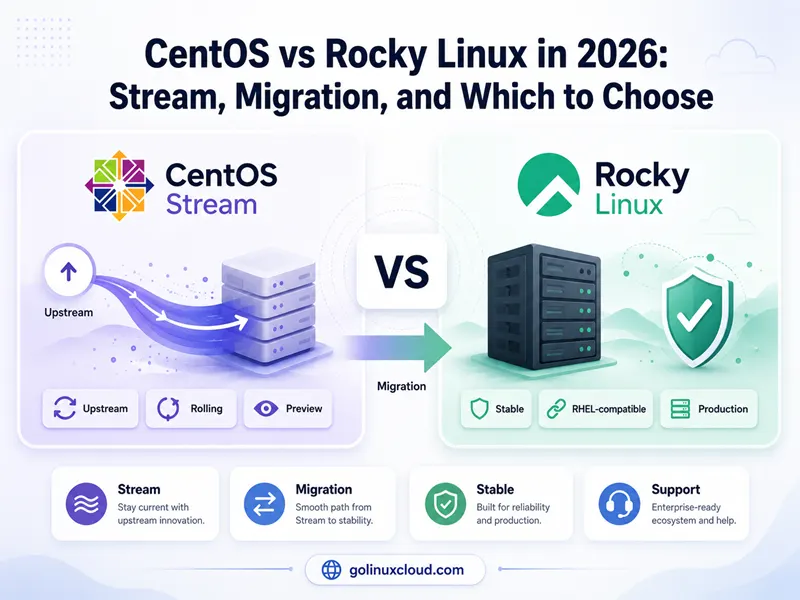
You are comparing CentOS vs Rocky Linux because runbooks still say “deploy on CentOS”—but CentOS Linux, the free downstream rebuild that defined Enterprise Linux for a generation, is end of life. What remains under the CentOS brand is CentOS Stream: the upstream branch where RHEL minors are developed. Rocky Linux is what many of those teams installed instead: a free, RESF-governed rebuild that rockylinux.org describes as bug-for-bug compatible with RHEL—founded by Gregory Kurtzer, a CentOS co-founder, explicitly to continue the CentOS Linux spirit after the 2020 shift.
This guide compares CentOS Stream 9 and 10 with Rocky Linux 9 and 10 in mid-2026, covers migrate2rocky from legacy CentOS Linux 8, and flags cPanel constraints that matter for former CentOS hosting fleets. Figures come from centos.org and docs.rockylinux.org—confirm on staging before production.
Quick answer: CentOS vs Rocky Linux in 2026
Pick Rocky Linux 9 or 10 when you need a production Enterprise Linux server after CentOS Linux—dnf, SELinux, 1:1 RHEL binary compatibility, and a 10-year support lifecycle at no OS license cost—and you are not blocked by cPanel 134+ or other panel matrices that dropped Rocky.
Pick CentOS Stream 9 or 10 when you develop, test, or contribute to the RHEL pipeline—previewing the next RHEL minor release—not when you want frozen downstream behavior like CentOS 7.
Do not install CentOS Linux 7 or 8 in 2026—they are EOL.
| Pick this | Best reason |
|---|---|
| Rocky Linux 10 | New EL10; security support to 2035-05-31 |
| Rocky Linux 9 | Mature 9.x fleet; security support to 2032-05-31 |
| CentOS Stream 10 | RHEL 10 upstream preview; EOL 2030-05-31 |
| CentOS Stream 9 | RHEL 9 upstream preview; EOL 2027-05-31 |
Related: CentOS vs AlmaLinux, CentOS vs Red Hat, Red Hat vs Rocky Linux, migrate CentOS to Rocky Linux.
CentOS vs Rocky Linux at a glance
| Topic | CentOS Stream 9/10 | Rocky Linux 9 | Rocky Linux 10 |
|---|---|---|---|
| Role vs RHEL | Upstream preview | Downstream 1:1 RHEL rebuild | Same |
| Replaces CentOS Linux? | No (different product) | Yes (primary intent) | Yes |
| Founder lineage | CentOS Project / Red Hat ecosystem | Gregory Kurtzer (CentOS co-founder), RESF | Same |
| Cost | Free | Free | Free |
| Compatibility goal | Next RHEL minor content | Bug-for-bug with RHEL | Bug-for-bug with RHEL |
| Update cadence | Continuous composes | Minor releases after RHEL GA | Same |
| Stream branch EOL | 9: 2027-05-31; 10: 2030-05-31 | — | — |
| Rocky active support ends | — | 2027-05-31 | 2030-05-31 |
| Rocky security support ends | — | 2032-05-31 | 2035-05-31 |
| Package tool | DNF / RPM | DNF / RPM | DNF / RPM |
| cPanel/WHM (v134+, 2026) | Not primary matrix | Not supported | Not supported |
| In-place from CentOS Linux 8 | Historical Stream swap | migrate2rocky | Fresh install / verify docs |
Sources: centos.org/cl-vs-cs, CentOS download, Rocky Linux, Rocky version guide, migrate2rocky.
What “CentOS” means—and where Rocky Linux fits
CentOS Linux is gone
In December 2020, the CentOS Project moved investment from CentOS Linux to CentOS Stream. Per Comparing CentOS Stream and CentOS Linux:
| Release | End of life |
|---|---|
| CentOS Linux 7 | 2024-06-30 |
| CentOS Linux 8 | 2021-12-31 |
| CentOS Stream 8 | 2024-05-31 |
CentOS Linux was a downstream rebuild of released RHEL—the OS behind countless hosting panels and yum tutorials.
CentOS Stream is upstream
CentOS Stream is the upstream, public development branch for RHEL. Content lands continuously—previewing upcoming RHEL minor releases—not mirroring a frozen RHEL minor like old CentOS Linux.
Rocky Linux continues the downstream clone model
Rocky Linux states it rebuilds sources directly from RHEL and is designed to be 100% bug-for-bug compatible with Red Hat Enterprise Linux. The Rocky Enterprise Software Foundation (RESF) governs the project; builds run through Rocky’s Peridot toolchain.
That positioning is deliberate: when CentOS Linux ended, Kurtzer and the community built Rocky to be the closest public continuation of the old “free RHEL clone” mental model—not the upstream preview role Stream took over.
CentOS Stream vs Rocky Linux: upstream vs downstream rebuild
| Dimension | CentOS Stream | Rocky Linux |
|---|---|---|
| Pipeline position | Before RHEL minor GA | After RHEL sources publish |
| Package versions | Often ahead of released RHEL | Aims to match RHEL NVRs |
| Best for | SIG work, preview testing | Production EL without subscription |
| Old CentOS Linux behavior | No | Closest free option (with AlmaLinux) |
| Red Hat production positioning | Development platform | Community production rebuild |
Red Hat Developer documentation states CentOS Stream is not designed for enterprise production the way RHEL is—Rocky targets operators who still want released-minor Enterprise Linux without a Red Hat invoice.
Support timelines
Rocky Linux
Per Rocky Linux Release and Version Guide:
| Major | GA | Active support until | Security support until |
|---|---|---|---|
| Rocky Linux 9 | 14 Jul 2022 | 2027-05-31 | 2032-05-31 |
| Rocky Linux 10 | 11 Jun 2025 | 2030-05-31 | 2035-05-31 |
| Rocky Linux 8 | 1 May 2021 | 2024-05-31 (ended) | 2029-05-31 |
Rocky Linux advertises a 10-year support lifecycle at no cost—RESF maintenance and Rocky errata, not Red Hat support cases.
CentOS Stream
Per centos.org/download and cl-vs-cs:
| Stream major | End-of-life |
|---|---|
| CentOS Stream 9 | 2027-05-31 |
| CentOS Stream 10 | 2030-05-31 |
Stream EOL aligns with RHEL full support for that major. Rocky’s security-support end dates can extend beyond Stream branch sunset on the same major—plan upgrades (9 → 10) as infrastructure projects on either side.
Migration from CentOS to Rocky Linux
CentOS Linux 8 → Rocky Linux (primary path)
Rocky’s migrate2rocky guide documents in-place conversion from CentOS Linux 8, CentOS Stream, AlmaLinux, RHEL, and Oracle Linux on EL8 or EL9. Our step-by-step: migrate CentOS to Rocky Linux.
Prerequisites from official docs:
- EL8 or EL9 (use
migrate2rocky9.shon 9.x) - Non-Stream CentOS frozen at 8.x for migration tooling—verify your minor
- Backup and staging test mandatory
- Read README for Katello / Satellite repo conflicts
Rocky 9 example:
curl -O https://raw.githubusercontent.com/rocky-linux/rocky-tools/main/migrate2rocky/migrate2rocky9.sh
chmod u+x migrate2rocky9.sh
sudo ./migrate2rocky9.sh -r
Verify:
cat /etc/rocky-release
hostnamectl
Lab host shape:
Rocky Linux release 9.4 (Blue Onyx)
Operating System: Rocky Linux 9.4 (Blue Onyx)
CentOS Linux 7 → Rocky Linux
There is no direct migrate2rocky path from CentOS 7 to Rocky 8+. You must upgrade to EL8 first (historically CentOS 8, now often reinstall or multi-hop tooling) or provision fresh Rocky and restore data. Our migration article documents the EL8-only script requirement:
This script must be run on an EL8 distribution. Migration from other distributions is not supported.CentOS Linux 8 → CentOS Stream 8 (historical)
CentOS documented conversion toward Stream, not Rocky:
sudo dnf swap centos-linux-repos centos-stream-repos
sudo dnf distro-sync
Stream 8 is EOL. Production-oriented CentOS Linux 8 hosts typically chose migrate2rocky or AlmaLinux—not Stream—as the migration target.
CentOS Stream → Rocky Linux
migrate2rocky lists CentOS Stream as a supported source on EL8/EL9—but you are moving from upstream preview to downstream rebuild. Treat it as a planned migration with staging validation, not a zero-risk repo flip.
| From | Rocky target | Tool |
|---|---|---|
| CentOS Linux 8 | Rocky 8 first | migrate2rocky |
| CentOS Linux 8 → Rocky 9/10 | Fresh install or separate major-upgrade plan | Rebuild / restore data |
| CentOS Linux 7 | Rocky 8+ | Reinstall or multi-hop plan first |
| CentOS Stream 9 | Rocky 9 | migrate2rocky9 with staging test |
| AlmaLinux/RHEL/Oracle Linux 8 or 9 | Matching Rocky major | migrate2rocky |
Package management and administration
Both Stream and Rocky use DNF, RPM, SELinux, and firewalld.
| Task | CentOS Stream | Rocky Linux |
|---|---|---|
| Install | sudo dnf install nginx |
Same |
| Release file | /etc/centos-release |
/etc/rocky-release |
| Extra repos | EPEL, CRB | EPEL — install on Rocky |
| Roll back updates | DNF history | Same |
# Rocky Linux
cat /etc/rocky-release
uname -r

# CentOS Stream
cat /etc/centos-release
uname -rRocky Linux release 9.8 (Blue Onyx)
5.14.0-687.el9.x86_64
CentOS Stream release 9
5.14.0-*.el9.x86_64Command reference: DNF command in Linux. Firewall: firewalld cheat sheet. Fresh install walkthrough: install Rocky Linux.
Web hosting and cPanel (critical for ex-CentOS shops)
Many CentOS Linux servers ran cPanel/WHM. In 2026:
- CentOS Linux is EOL—do not build new panel servers on it.
- CentOS Stream is not the usual cPanel target.
- Rocky Linux 8/9 is not supported on cPanel 134+ (January 2026)—new installs and upgrades are blocked per cPanel release notes.
| Hosting scenario | Practical pick |
|---|---|
| New cPanel server (2026) | AlmaLinux 9/10 or Ubuntu 24.04—not Rocky |
| Legacy Rocky + old cPanel | Plan AlmaLinux migration before panel updates |
| General EL VPS (no panel) | Rocky 9/10 strong fit |
| RHEL preview lab | CentOS Stream |
Former CentOS hosts that moved to Rocky for cPanel may need almalinux-deploy—see CentOS vs AlmaLinux and AlmaLinux vs Rocky Linux.
Architectures and EL10 baselines
Rocky ships x86_64, aarch64, ppc64le, s390x, and documents riscv64 on supported platforms per Rocky documentation.
| EL10 x86_64 | Rocky Linux 10 | CentOS Stream 10 |
|---|---|---|
| CPU baseline | x86_64_v3 (Haswell-era class) | x86_64_v3 class |
| Older pre-v3 hardware | Hardware refresh or stay on EL9 | Same |
AlmaLinux 10 offers x86_64_v2 images for older 64-bit servers—Rocky does not target v2 on EL10. See AlmaLinux vs Rocky Linux if CPU age drives your choice.
Workload guide: CentOS Stream vs Rocky Linux
| Workload | CentOS Stream | Rocky Linux |
|---|---|---|
| Replace CentOS Linux production | Poor fit | Strong fit |
| cPanel / WHM new builds (2026) | Not primary | Blocked on v134+ |
| RHEL ecosystem contribution | Strong fit | Secondary |
| ISV apps certified on RHEL | Test on Stream; run on Rocky/RHEL | Strong fit |
| Strict RHEL NVR / binary parity | Lagging until RHEL GA | Strong fit |
| Kubernetes / nginx / PostgreSQL | Preview labs | Strong fit |
| CI previewing next RHEL minor | Strong fit | Rebuild after RHEL publishes |
| Cost-sensitive EL fleet | Free (preview cadence) | Free (downstream cadence) |
Who should choose CentOS Stream vs Rocky Linux
Choose Rocky Linux when
- You are migrating from CentOS Linux 8 with migrate2rocky.
- You want the closest 1:1 RHEL binary clone at no license cost.
- Your ISV matrix or internal standard names Rocky without cPanel constraints.
- You prefer RESF governance and the project founded by a CentOS co-founder.
Choose CentOS Stream when
- You contribute to Enterprise Linux SIGs or test upcoming RHEL minors.
- You need upstream visibility ahead of RHEL GA—not CentOS 7-style stability.
- You partner with Red Hat on pipeline validation.
Choose AlmaLinux instead of Rocky when
- You run cPanel 134+ or need x86_64_v2 on EL10—see CentOS vs AlmaLinux.
Choose RHEL instead of both when
- Contracts require Red Hat subscriptions and Convert2RHEL—see CentOS vs Red Hat.
Common mistakes
- Treating CentOS Stream as “the new CentOS Linux” — use Rocky or AlmaLinux for downstream production.
- Migrating CentOS 7 directly to Rocky 8+ — migrate2rocky requires EL8+; upgrade or reinstall first.
- Deploying Rocky for new cPanel in 2026 — panel support ended; use AlmaLinux.
- Skipping staging before migrate2rocky — custom kernels, panels, and Katello repos break silently.
- Assuming Rocky equals CentOS Stream — Stream is upstream; Rocky is downstream rebuild.
- Staying on CentOS Linux 7 — EOL June 2024; migrate urgently.
- Ignoring EL10 CPU baselines — Rocky 10 expects x86_64_v3 on default x86 media.
Summary
CentOS Linux—the downstream free rebuild—is end of life. CentOS Stream is the upstream RHEL development branch through Stream 9 (EOL 2027-05-31) and Stream 10 (EOL 2030-05-31). Rocky Linux 9 and 10 are free, RESF-governed rebuilds that aim for bug-for-bug compatibility with RHEL—the path most CentOS Linux operators chose for production after 2021, with security support through 2032 (9) or 2035 (10).
Choose Rocky Linux to replace CentOS Linux on general EL servers. Choose CentOS Stream to preview RHEL. Do not greenfield EOL CentOS Linux. Run migrate2rocky on staging, validate workloads, and if you run cPanel, confirm you are not on Rocky-blocked panel branches before you commit.
Official references: CentOS Project, CentOS cl-vs-cs, Rocky Linux, Rocky version guide, migrate2rocky, Rocky errata.
On-site next steps: migrate CentOS to Rocky Linux, CentOS vs AlmaLinux, Red Hat vs Rocky Linux, AlmaLinux vs Rocky Linux, install Rocky Linux.