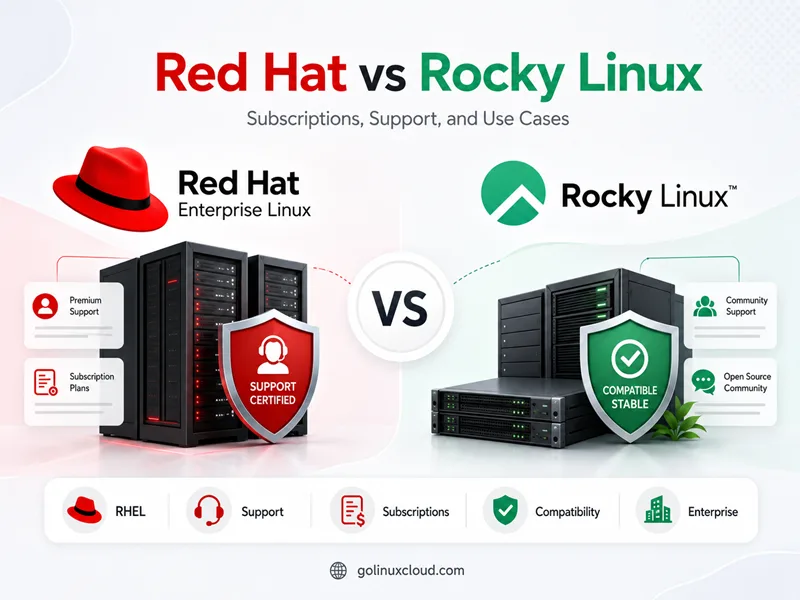
You are choosing between Red Hat Enterprise Linux (RHEL) and Rocky Linux because both names appear on the same architecture diagrams—dnf, SELinux, RPM, firewalld—and both claim Enterprise Linux compatibility. They are not the same product. RHEL is Red Hat’s subscription operating system: certifications, RHSA errata, Red Hat Insights, live kernel patching, and vendor support tied to a Customer Portal account. Rocky Linux is a free community rebuild from the Rocky Enterprise Software Foundation (RESF) that aims to be bug-for-bug compatible with RHEL—the spiritual successor to old CentOS Linux for teams that will not buy Red Hat licenses.
This guide compares RHEL 9 and 10 with Rocky Linux 9 and 10 in mid-2026 on cost, support, compatibility, migration, compliance, and production roles—not desktop politics. Rocky-side command shapes match our Rocky Linux install guide; RHEL lifecycle figures come from access.redhat.com and Rocky dates from wiki.rockylinux.org—confirm on the VMs and contracts you provision.
Quick answer: Red Hat vs Rocky Linux in 2026
Pick RHEL 9 or 10 when procurement, auditors, or ISV contracts require Red Hat Enterprise Linux by name—subscription-backed RHSA closure, Insights, kpatch, Satellite, EUS pinning, and formal hardware/software certifications.
Pick Rocky Linux 9 or 10 when you need RHEL-compatible binaries at no OS license cost, your stack runs fine on a community EL rebuild, and community or partner support (for example CIQ) meets your operational SLA—understanding Rocky publishes its own errata, not Red Hat support tickets.
| Pick this | Best reason |
|---|---|
| RHEL 10 | Current major; EL10 toolchains; 10-year Red Hat lifecycle |
| RHEL 9 | Mature ISV/SAP matrices; widest 9.x certification |
| Rocky Linux 10 | Free RHEL 10 rebuild; security support to 2035-05-31 |
| Rocky Linux 9 | Free RHEL 9 rebuild; security support to 2032-05-31 |
If you are choosing between free EL rebuilds, see AlmaLinux vs Rocky Linux—cPanel and ABI philosophy differ. For CentOS Stream vs RHEL, see CentOS vs Red Hat.
Red Hat vs Rocky Linux at a glance
| Topic | RHEL 9 | RHEL 10 | Rocky Linux 9 | Rocky Linux 10 |
|---|---|---|---|---|
| Maintainer | Red Hat (commercial) | Red Hat | RESF (community) | RESF |
| Cost | Subscription | Subscription | Free | Free |
| Red Hat commercial support | Yes (per tier) | Yes | No (partner options) | No |
| Compatibility goal | Reference product | Reference product | 1:1 binary with RHEL | 1:1 binary with RHEL |
| Package tool | DNF / RPM | DNF / RPM | DNF / RPM | DNF / RPM |
| MAC / firewall | SELinux + firewalld | Same | Same | Same |
| RHEL lifecycle | 10-year model | 10-year model | Tracks RHEL majors | Tracks RHEL majors |
| Rocky active support ends | — | — | 2027-05-31 | 2030-05-31 |
| Rocky security support ends | — | — | 2032-05-31 | 2035-05-31 |
| RHSA / Red Hat errata | Subscription portal | Same | Rocky errata (separate) | Same |
| Insights / Satellite / kpatch | Subscription features | Same | Not included | Not included |
| migrate2rocky (→ Rocky) | Supported from RHEL 8/9 | EL10: verify docs | N/A | N/A |
| Convert2RHEL (→ RHEL) | Destination | Destination | Selected paths per Red Hat matrix | Verify current matrix |
| cPanel/WHM (v134+, 2026) | N/A (use Alma) | N/A | Not supported | Not supported |
Sources: RHEL lifecycle, RHEL release dates, Rocky Linux, Rocky version guide, cPanel release notes.
Same stack, different vendor relationship
Rocky Linux and RHEL share the Enterprise Linux userland: systemd, OpenSSH, crypto-policies, SELinux policies, and AppStream module patterns. Operators type the same commands:
sudo dnf install nginx
sudo systemctl enable --now nginx
sudo firewall-cmd --permanent --add-service=http
The split is who builds binaries, who signs errata, and who answers at 3 a.m. when an auditor or ISV asks for proof.
RHEL — commercial reference platform
RHEL is what hardware OEMs, SAP, Oracle, and regulated industries certify against by name. Updates arrive as RHSA and RHBA advisories through a subscription. Red Hat Insights prioritizes CVEs; kpatch can apply critical kernel fixes without reboots on entitled systems.
Rocky Linux — community rebuild
Rocky Linux states it rebuilds sources directly from RHEL and targets bug-for-bug compatibility—the closest free substitute to old CentOS Linux. The RESF governs the project; engineering is community- and sponsor-backed (including partners such as CIQ). Rocky publishes its own errata and advisory streams—not Red Hat support cases.
Compatibility: what “bug-for-bug” means in practice
Rocky’s public positioning is 1:1 binary compatibility with RHEL—RPM NVRs and behavior should match what Red Hat shipped for a given minor, rebuilt through Rocky’s Peridot toolchain after RHEL sources publish.
| Scenario | Typical outcome |
|---|---|
dnf install the same package names on RHEL 9.8 and Rocky 9.8 |
Same EL conventions; NVRs should align closely |
Vendor installer checks for redhat-release |
May pass on Rocky; verify vendor docs |
| Compliance asks for Red Hat subscription IDs | Rocky does not substitute |
| Kernel module built for RHEL 9 | Intended to load on Rocky 9 |
| Script checksums exact Red Hat NVR strings | Usually works on Rocky; rare timing skew right after RHEL GA |
AlmaLinux chose ABI compatibility instead of strict clone parity—a different trade-off covered in AlmaLinux vs Rocky Linux.
Support, lifecycle, and errata
RHEL 10-year model
RHEL 8, 9, and 10 each target a 10-year lifecycle: Full Support, Maintenance Support, and Extended Life Phase. Minor releases ship about every six months during Full Support; Extended Update Support (EUS) and Enhanced EUS let you pin minors with add-ons.
| Major | GA date | Role in mid-2026 |
|---|---|---|
| RHEL 9 | 17 May 2022 | Mature enterprise standard |
| RHEL 10 | 20 May 2025 | Current major |
RHEL 10.2 reached GA on 19 May 2026 per Red Hat release dates.
Rocky published dates
Per Rocky Linux Release and Version Guide:
| Major | GA | Active support until | Security support until |
|---|---|---|---|
| Rocky Linux 9 | 14 Jul 2022 | 2027-05-31 | 2032-05-31 |
| Rocky Linux 10 | 11 Jun 2025 | 2030-05-31 | 2035-05-31 |
| Rocky Linux 8 | 1 May 2021 | 2024-05-31 (ended) | 2029-05-31 |
Rocky Linux advertises a 10-year support lifecycle aligned with RHEL majors at no cost—but that is RESF maintenance, not a Red Hat phone ticket.
Errata and patching
| Layer | RHEL | Rocky Linux |
|---|---|---|
| Security advisories | RHSA via Customer Portal | Rocky errata |
| Support SLA | Contractual (severity tiers) | Community / partner |
| Live kernel patches | kpatch (entitled) | Reboot for kernel updates |
| CVE prioritization | Insights (subscription) | Your monitoring + Rocky advisories |
Rocky typically rebuilds shortly after RHEL publishes sources—often within about a day for critical fixes—but you still track Rocky’s advisory IDs in change management, not Red Hat’s.
Cost and subscriptions
| Option | OS license | Typical support |
|---|---|---|
| RHEL production | Paid subscription | Red Hat support tiers |
| RHEL Developer (individual) | No-cost under terms | Developer subscription limits |
| Rocky Linux | Free | Community forums, RESF; commercial via partners |
| AlmaLinux | Free | Alternative rebuild—see comparison article |
For teams that left CentOS Linux to avoid subscriptions, Rocky (or AlmaLinux) is the usual destination. For teams that must show Red Hat spend to satisfy enterprise agreements, RHEL remains the billable line item.
Features you get with RHEL subscriptions (not Rocky)
Red Hat’s enterprise stack attaches to subscriptions, not to Rocky installs:
- Red Hat Insights — configuration drift, CVE exposure, remediation playbooks
- Red Hat Satellite — curated content, patching at scale
- kpatch — live kernel updates for critical/important CVEs on entitled systems
- Convert2RHEL — supported in-place migration from CentOS Linux, Oracle Linux, AlmaLinux, and Rocky Linux to matching RHEL releases (verify the current matrix)
- Formal certifications — FIPS programs, government lists, OEM hardware certs under Red Hat branding
Rocky inherits SELinux, OpenSCAP content, and the same crypto-policies family—but compliance officers asking for “Red Hat support case numbers” will not accept Rocky errata URLs alone.
Migration: RHEL ↔ Rocky and the EL family
migrate2rocky (toward Rocky)
Rocky’s migrate2rocky guide documents in-place conversion from RHEL 8/9, CentOS 8, AlmaLinux, Oracle Linux, and related EL8/EL9 systems to Rocky—swapping repositories and syncing packages. Our walkthrough: migrate CentOS to Rocky Linux.
Prerequisites and caveats from official docs:
- Target EL8 or EL9 (use
migrate2rocky9.shon 9.x) - Backup and test on staging
- Conflicts possible with Katello / Satellite-managed repos—read the script README
- After migration you are on Rocky repos, not entitled RHEL repos
Example flow (Rocky 9):
curl -O https://raw.githubusercontent.com/rocky-linux/rocky-tools/main/migrate2rocky/migrate2rocky9.sh
chmod u+x migrate2rocky9.sh
sudo ./migrate2rocky9.sh -r
Verify:
cat /etc/rocky-release
hostnamectl
Example shape after conversion:
Rocky Linux release 9.8 (Blue Onyx)
Operating System: Rocky Linux 9.8 (Blue Onyx)
Convert2RHEL (toward RHEL)
Red Hat Convert2RHEL supports selected conversions from Rocky Linux, AlmaLinux, CentOS Linux, and Oracle Linux to matching RHEL releases. Verify the current supported source/target matrix before planning production, because this is not a generic “any Rocky version to any RHEL version” upgrade path. For Rocky 9/10 estates, check Red Hat’s current Convert2RHEL documentation or use fresh RHEL provisioning if your target path is not listed.
Prerequisites mirror other EL conversions: valid RHEL subscriptions, backups, staging tests, and subscription-manager register after a successful conversion.
Day-to-day administration
Routine ops are nearly identical—which is why the decision is commercial and compliance, not syntactic.
| Task | RHEL (subscribed) | Rocky Linux |
|---|---|---|
| Register / entitle | subscription-manager register |
Not used |
| Install package | sudo dnf install pkg |
Same |
| List repos | subscription-manager repos |
dnf repolist |
| SELinux troubleshooting | ausearch, restorecon |
Same |
| Extra packages | EPEL, vendor .repo |
Same — EPEL on Rocky |
| Roll back bad update | DNF history | Same |
| Firewall | firewalld | Same |
On a subscribed RHEL host:
cat /etc/redhat-release
subscription-manager status
On Rocky:
cat /etc/rocky-release
uname -r
Lab host used for this article:
Rocky Linux release 9.8 (Blue Onyx)
5.14.0-687.el9.x86_64
Command deep dive: DNF command in Linux.
Hardware, architectures, and EL10 baselines
Both RHEL 10 and Rocky Linux 10 raised the x86_64 baseline toward x86_64_v3 (roughly Haswell-era and newer). Rocky ships aarch64, ppc64le, s390x, and documents riscv64 on supported platforms per Rocky documentation.
| Topic | RHEL 10 | Rocky Linux 10 |
|---|---|---|
| x86_64 default | x86_64_v3 class | x86_64_v3 |
| ARM / IBM Z / POWER | Supported enterprise arches | Supported per release notes |
| Older pre-v3 CPUs on EL10 | Hardware refresh typically required | Same—AlmaLinux x86_64_v2 may be the EL10 exception |
Verify CPU compatibility before you standardize on EL10—see AlmaLinux vs Rocky Linux for the v2 media split.
Workload guide: RHEL vs Rocky Linux
| Workload | RHEL | Rocky Linux |
|---|---|---|
| SAP / Oracle “certified on RHEL” | Strong fit | Verify matrix; may run but not substitute contract |
| Regulated industry requiring Red Hat support | Strong fit | Poor fit unless policy allows rebuilds |
| General nginx / PostgreSQL / K8s worker | Excellent with subscription | Excellent at no OS cost |
| CI runners matching released RHEL minor | Strong fit | Strong fit when NVR parity matters |
| Shared hosting (cPanel/WHM, 2026) | Use AlmaLinux path | Blocked on cPanel 134+ |
| Cost-sensitive EL fleet | Subscription line item | Strong fit |
| Need Insights / kpatch / Satellite | Strong fit | Not included |
| Leaving paid RHEL to cut OS licenses | N/A | migrate2rocky after legal/support review |
For hosting specifically, cPanel version 134 (January 2026) discontinued Rocky Linux 8 and 9—new panel installs should use AlmaLinux or Ubuntu 24.04 per cPanel release notes. That is a practical 2026 gap other “RHEL vs Rocky” posts skip.
Who should choose RHEL vs Rocky Linux
Choose RHEL when
- Contracts, RFPs, or auditors name Red Hat Enterprise Linux and Red Hat support.
- You rely on Insights, Satellite, kpatch, or EUS pinning.
- ISV support requires a subscription ID or Red Hat case history.
- You are migrating CentOS Linux with Convert2RHEL into a supported Red Hat estate.
Choose Rocky Linux when
- You need RHEL-compatible behavior without OS subscription cost.
- Your ISV matrix lists Rocky or generic “RHEL-compatible” EL without mandating Red Hat invoices.
- You accept RESF/community or partner support instead of Red Hat SLAs.
- You are standardizing a large EL fleet after CentOS Linux and want strict binary parity with RHEL (versus Alma’s ABI model).
Reconsider Rocky if
- You run cPanel/WHM on current branches—migrate to AlmaLinux.
- Compliance language forbids non-Red Hat builds regardless of compatibility.
- You need live kernel patching without reboots—budget RHEL or operational workarounds.
Common mistakes
- Assuming Rocky includes Red Hat support — errata and forums are not Sev-1 Red Hat tickets.
- Deploying Rocky for new cPanel builds in 2026 — panel support ended on Rocky from v134 onward.
- Migrating production RHEL to Rocky without legal review — subscription terms and ISV contracts may forbid or require notice.
- Assuming every Rocky release converts to every RHEL target with Convert2RHEL—verify Red Hat’s current supported matrix before production.
- Ignoring minor versions — “RHEL 9” vs “Rocky 9.7” still matters for ISV pins and kernel modules.
- Skipping
subscription-manageron RHEL — unsubscribed RHEL lacks entitled repos; Rocky has no equivalent step. - Treating Rocky as CentOS Stream — Stream is RHEL upstream; Rocky is a downstream rebuild—see CentOS vs Red Hat.
Summary
Red Hat Enterprise Linux is the subscription-backed, certified Enterprise Linux product: 10-year lifecycles, RHSA errata, Insights, kpatch, and vendor matrices that name RHEL explicitly. Rocky Linux is a free, RESF-governed rebuild that aims for bug-for-bug compatibility with RHEL—same DNF and SELinux day to day, different vendor relationship and no Red Hat support contract.
Choose RHEL when audits, ISVs, or internal policy require Red Hat by name. Choose Rocky when RHEL-compatible binaries at no license cost fit your SLA and compliance wording. Use migrate2rocky to move eligible RHEL 8/9 (and other EL) systems to Rocky; use Convert2RHEL and subscriptions for supported paths from Rocky, AlmaLinux, CentOS Linux, or Oracle Linux to RHEL—verify the matrix first. For panel hosting in 2026, prefer AlmaLinux over Rocky.
Provision one VM of each on your cloud SKU, run your installer and compliance checklist, and compare contract language and errata workflows—not mascot preference.
Official references: Red Hat Enterprise Linux, RHEL lifecycle, Rocky Linux, Rocky version guide, migrate2rocky, Convert2RHEL.
On-site next steps: AlmaLinux vs Rocky Linux, CentOS vs Red Hat, Debian vs Red Hat, migrate CentOS to Rocky Linux, install Rocky Linux.