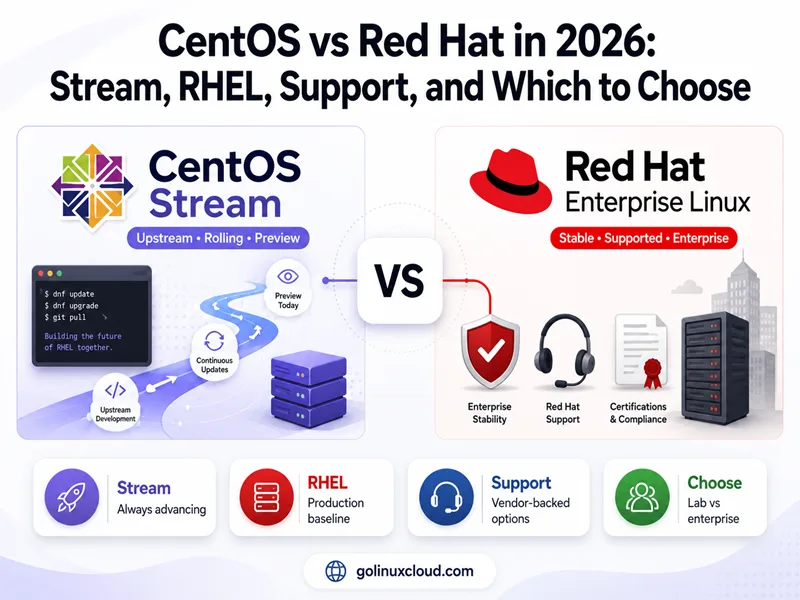
You are comparing CentOS vs Red Hat because a runbook, vendor PDF, or old AMI still says “CentOS”—but “CentOS” no longer means one product. CentOS Linux, the free downstream rebuild of Red Hat Enterprise Linux (RHEL), is end of life. What remains is CentOS Stream: the upstream, continuously delivered branch where RHEL minor releases are developed. RHEL is Red Hat’s subscription enterprise OS—certified, errata-backed, and built for production fleets.
This guide compares CentOS Stream 9 and 10 with RHEL 9 and 10 in mid-2026, explains what changed after the 2020 CentOS shift, and covers Convert2RHEL, subscriptions, and when AlmaLinux fits the “free CentOS-like” role instead. Figures come from centos.org, redhat.com, and Red Hat’s lifecycle policy—verify on the images and contracts you provision before you freeze production.
Quick answer: CentOS vs Red Hat in 2026
Pick RHEL when you run production workloads that need Red Hat subscriptions, 10-year lifecycle documentation, RHSA errata, certifications, Red Hat Insights, live kernel patching, and vendor matrices that say “supported on RHEL.”
Pick CentOS Stream 9 or 10 when you develop, test, or contribute to the RHEL ecosystem—previewing the next RHEL minor release, validating hardware or software against upcoming RHEL content, or collaborating with Red Hat engineers on the same codebase—accepting no commercial support and continuous update cadence.
Pick AlmaLinux or Rocky Linux—not Stream—when you want free RHEL-compatible production after CentOS Linux without a Red Hat bill. See AlmaLinux vs Rocky Linux.
| Pick this | Best reason |
|---|---|
| RHEL 10 | Current major; EL10 toolchains; 10-year lifecycle |
| RHEL 9 | Mature ISV/SAP matrices; wide 9.x fleet |
| CentOS Stream 10 | RHEL 10 upstream preview; EOL 2030-05-31 |
| CentOS Stream 9 | RHEL 9 upstream preview; EOL 2027-05-31 |
| AlmaLinux 9/10 | Free RHEL rebuild for production |
Related: CentOS vs Ubuntu, Debian vs Red Hat, migrate CentOS to Rocky Linux.
CentOS vs RHEL at a glance
| Topic | CentOS Stream 9/10 | RHEL 9 | RHEL 10 |
|---|---|---|---|
| Role in pipeline | Upstream of RHEL minors | Shipping enterprise product | Shipping enterprise product |
| Cost | Free download | Subscription (Developer program for individuals) | Same |
| Red Hat commercial support | No | Yes (per tier) | Yes |
| Typical production use | Dev/test/contribute (per Red Hat) | Production enterprise | Production enterprise |
| Update cadence | Continuous composes (2–3×/week typical) | Predictable minor releases ~6 months | Same |
| Stream/RHEL branch EOL | Stream 9: 2027-05-31; Stream 10: 2030-05-31 | 10-year lifecycle per major | 10-year lifecycle |
| Package tool | DNF / RPM | DNF / RPM | DNF / RPM |
| MAC security | SELinux (enforcing typical) | SELinux enforcing | SELinux enforcing |
| Live kernel patching | No (per Red Hat checklist) | kpatch for critical/important CVEs | Same |
| Convert2RHEL target | Not supported | N/A (destination) | N/A (destination) |
| Certifications (FIPS, ISV, OEM) | No | Yes (product-dependent) | Yes |
| Management | Community SIGs | Satellite, Insights, Ansible | Same |
Sources: CentOS download, Comparing CentOS Linux and Stream, What is CentOS Stream?, CentOS and RHEL (Red Hat Developer), RHEL lifecycle.
Three names people confuse: CentOS Linux, CentOS Stream, and RHEL
The Fedora → Stream → RHEL pipeline
Enterprise Linux development flows through distinct stages:
Fedora (innovation) → CentOS Stream (midstream preview) → RHEL (production release)Per Red Hat’s CentOS Stream overview, Red Hat develops RHEL source in CentOS Stream before shipping new RHEL versions. RHEL 9 was the first major built within that model. Stream content becomes the next RHEL minor release—a rolling preview, not a frozen downstream clone.
CentOS Linux (legacy, EOL)
CentOS Linux was a downstream rebuild of released RHEL—lagging RHEL minors, not previewing them. Per centos.org/cl-vs-cs:
| Release | End of life |
|---|---|
| CentOS Linux 7 | 2024-06-30 |
| CentOS Linux 8 | 2021-12-31 |
| CentOS Stream 8 | 2024-05-31 |
The December 2020 announcement ended new CentOS Linux builds; the project focus moved to CentOS Stream.
RHEL (commercial product)
Red Hat Enterprise Linux is hardened for long maintenance, certification, and commercial support. Updates arrive as RHSA security advisories and RHBAs bug advisories through a subscription and the Red Hat Customer Portal.
CentOS Stream vs RHEL: upstream vs shipping
| Dimension | CentOS Stream | RHEL |
|---|---|---|
| Position | Upstream—preview of next RHEL minor | Downstream—current supported enterprise release |
| Who it is for | Contributors, ISV/IHV testers, RHEL pipeline participants | Production datacenters, regulated industries, certified stacks |
| Update timing | Packages land as composes are ready (CentOS blog) | Batched into minor releases during Full Support; EUS options to pin |
| Security CVE flow | Generally after current RHEL release (distro FAQ); embargoes follow Red Hat policy | RHSA errata with subscription access |
| Branding / repos | CentOS branding, community mirrors | Red Hat branding, Subscription Manager repos |
Per centos.org/cl-vs-cs, CentOS Stream receives content planned for upcoming RHEL minor releases as updates are ready—not only in large minor GA batches like old CentOS Linux.
The CentOS Project FAQ states Stream is not “RHEL beta”: it generally gets fixes and features ahead of RHEL while indicating what will ship in RHEL.
Support, lifecycle, and subscriptions
RHEL 10-year model
RHEL 8, 9, and 10 each target a 10-year lifecycle: Full Support, Maintenance Support, and Extended Life Phase. Minor releases ship about every six months during Full Support; Extended Update Support (EUS) and Enhanced EUS let you pin a minor longer with add-ons.
| Major | GA date | Role in mid-2026 |
|---|---|---|
| RHEL 9 | 17 May 2022 | Mature enterprise standard; wide ISV certs |
| RHEL 10 | 20 May 2025 | Current major; EL10 toolchains |
RHEL 10.2 reached GA on 19 May 2026 per Red Hat release dates.
CentOS Stream branch lifetimes
The CentOS download page publishes Stream end-of-life aligned with RHEL full support:
| Stream major | End-of-life |
|---|---|
| CentOS Stream 9 | 2027-05-31 |
| CentOS Stream 10 | 2030-05-31 |
Red Hat Developer documentation contrasts Stream with RHEL: Stream has no commercial support and updates for roughly the five-year full-support window of its RHEL major—not the full 10-year RHEL lifecycle with Maintenance and Extended Life phases.
Cost model
| Option | Cost | Support |
|---|---|---|
| CentOS Stream | Free | Community / CentOS SIGs |
| RHEL production | Paid subscription | Red Hat support tiers + errata |
| RHEL Developer subscriptions | No-cost for qualifying development use | Not a replacement for general production fleet licensing |
| AlmaLinux / Rocky | Free | Vendor/community (not Red Hat) |
For individual developers, Red Hat Developer subscriptions provide no-cost RHEL access under defined terms—not the same as unlimited production fleet licensing.
Production features Red Hat documents for RHEL (not Stream)
Red Hat’s CentOS and RHEL guide lists differences that matter in procurement:
CentOS Linux (historical) vs RHEL
Even when CentOS Linux existed, Red Hat documented that it was not the same as RHEL:
- No government or public security certifications on CentOS Linux
- Not certified by many hardware/software vendors or as guest/host on Red Hat platforms
- Different build/test environment; some RHEL components absent; extra packages possible
- No advanced automation stack, certified live kernel patches, or in-place upgrade tooling
- Never supported by Red Hat
CentOS Stream vs RHEL (2026 checklist)
Red Hat’s four key differences (summarized from developers.redhat.com):
| Area | RHEL | CentOS Stream |
|---|---|---|
| Lifecycle | 10-year model; upgrade tooling | ~5-year Stream branch; manual major moves |
| Updates | Predictable minor schedule; live kernel patches | Continuous updates; restart for kernel fixes |
| Security/compliance | Insights, certifications, targeted guidance | Does not carry the same subscription-backed certification, compliance, and support artifacts as RHEL; features and fixes arrive together |
| Migration | Convert2RHEL from CentOS Linux | Not Convert2RHEL-compatible |
Package management: same tools, different repos
Both Stream and RHEL use DNF and RPM. Day-one commands look identical; repositories, branding, and subscription entitlements differ.
| Task | CentOS Stream | RHEL (subscribed) |
|---|---|---|
| Install | sudo dnf install nginx |
sudo dnf install nginx |
| Register system | Not applicable | subscription-manager register |
| List repos | dnf repolist |
subscription-manager repos |
| Security advisories | Community tracking | RHSA via Customer Portal |
| Web server package | httpd or nginx |
httpd or nginx |
On RHEL, packages flow through Subscription Manager and entitled repos. On Stream, mirrors and CentOS composes replace that layer.
# Shape on CentOS Stream
cat /etc/centos-release
dnf --version

# Shape on subscribed RHEL
cat /etc/redhat-release
subscription-manager status
Typical output shapes (verify on your VM):
CentOS Stream release 9
dnf 4.x ...

Red Hat Enterprise Linux release 10.2 (Coughlan)
Overall Status: Current
Command reference: DNF command in Linux. Rollbacks: YUM/DNF history and rollback.
Security: SELinux on both; compliance only on RHEL
Stream and RHEL both ship SELinux and firewalld as Enterprise Linux norms. The gap is process and proof:
- RHEL: RHSA errata, FIPS-capable builds (product/options), vendor certification programs, Red Hat Insights for configuration drift and CVE prioritization
- CentOS Stream: community composes, CVE handling after current RHEL per distro FAQ Q4; does not carry the same Red Hat subscription-backed certification, compliance, and support artifacts that enterprise customers usually require from RHEL
For regulated workloads, auditors usually want RHEL subscription evidence—not “we run Stream because it feels like RHEL.”
Migration paths
| From | To | Tool / approach |
|---|---|---|
| CentOS Linux 7 | RHEL 7 first, then upgrade to newer RHEL if needed | Convert2RHEL + Leapp / fresh install |
| CentOS Linux 8 | RHEL 8 first | Convert2RHEL, then upgrade if needed |
| CentOS Linux | AlmaLinux / Rocky | almalinux-deploy / migrate2rocky |
| CentOS Stream | RHEL | Reinstall or reprovision—not Convert2RHEL |
| CentOS Stream | AlmaLinux / Rocky | Reinstall or tested migration plan |
Per Red Hat, Convert2RHEL migrates CentOS Linux (and Oracle Linux) to RHEL—it does not support CentOS Stream. If you deploy Stream as an interim platform, plan RHEL (or Alma/Rocky) as a reinstall project.
CentOS Linux 8 → Stream 8 conversion (historical only—Stream 8 is EOL):
sudo dnf swap centos-linux-repos centos-stream-repos
sudo dnf distro-sync
Workload guide: CentOS Stream vs RHEL
| Workload | CentOS Stream | RHEL |
|---|---|---|
| Production SAP / Oracle certified stacks | Poor fit | Strong fit |
| Regulated industry (PCI, FedRAMP-style asks) | Poor fit | Strong fit with subscription |
| ISV/IHV “day 1” RHEL testing | Strong fit | Use RHEL for final cert matrix |
| Contributing patches to RHEL minors | Strong fit | Use roadmap + support channels |
| CI matching released RHEL minor | Use RHEL or Alma/Rocky | Strong fit |
| CI previewing next RHEL minor | Strong fit | Lagging until minor GA |
| Homelab learning EL | Good free option | Developer subscription |
| Shared hosting (cPanel) | Not primary matrix | Use AlmaLinux or Ubuntu per vendor |
| Long-life unmaintained server | Do not use Stream as CentOS Linux substitute | RHEL + lifecycle planning |
For hosting panels and PHP repo patterns on free EL rebuilds, see AlmaLinux vs Ubuntu.
Who should choose CentOS Stream vs RHEL
Choose CentOS Stream when
- You test hardware or software against what RHEL will ship next, per CentOS Stream’s mission.
- You contribute to Enterprise Linux SIGs or want the same codebase Red Hat engineers use during RHEL development.
- You run non-production labs that benefit from early visibility into RHEL minor content.
Choose RHEL when
- Production uptime, vendor support, and audit evidence require a Red Hat subscription.
- ISV documentation lists “RHEL 9.x / 10.x” without listing Stream or rebuilds.
- You need live kernel patching, Insights, EUS pinning, or Convert2RHEL from legacy CentOS Linux.
Choose AlmaLinux or Rocky when
- You need RHEL-compatible binaries without a Red Hat invoice—the role CentOS Linux filled for many years.
- cPanel or EL hosting matrices list AlmaLinux but not CentOS Stream.
Common mistakes
- Installing CentOS Stream expecting old CentOS Linux stability — Stream is upstream preview; production EL clones are Alma/Rocky or RHEL.
- Assuming Convert2RHEL works from Stream — it targets CentOS Linux, not Stream.
- Treating Stream as “free RHEL” for audits — subscription-backed certifications and Red Hat support attach to RHEL, not Stream.
- Staying on CentOS Linux 7 in 2026 — EOL since June 2024; migrate to RHEL, Alma, or Rocky.
- Ignoring Stream EOL dates — Stream 9 ends 2027-05-31; plan before branch sunset.
- Confusing Fedora with Stream — Fedora is faster innovation; Stream is the RHEL midstream defined on centos.org.
- Skipping subscription-manager on RHEL — unsubscribed RHEL hosts lack entitled repos; Stream does not use Subscription Manager.
Summary
CentOS in 2026 means CentOS Stream—the free upstream platform where RHEL minor releases are developed, with continuous updates through Stream 9 (EOL 2027-05-31) and Stream 10 (EOL 2030-05-31). CentOS Linux, the downstream RHEL rebuild, is end of life and was never Red Hat–supported.
RHEL 9 and 10 are the shipping, subscription-backed enterprise products: 10-year lifecycles, RHSA errata, certifications, Insights, live kernel patching, and Convert2RHEL from legacy CentOS Linux. They are not interchangeable with Stream—Stream previews RHEL; RHEL is what vendors certify.
For free production RHEL compatibility after CentOS Linux, use AlmaLinux or Rocky Linux. For paid production with Red Hat backing, migrate CentOS Linux to RHEL or subscribe on new hardware. Provision test VMs, run your ISV installer or panel checklist, and compare support contracts and lifecycle dates—not decade-old “CentOS = free RHEL” shorthand.
Official references: CentOS Project, CentOS Stream FAQ, What is CentOS Stream?, CentOS and RHEL (Developer), RHEL lifecycle, Convert2RHEL guide.
On-site next steps: CentOS vs Ubuntu, Debian vs Red Hat, AlmaLinux vs Rocky Linux, migrate CentOS to Rocky Linux.