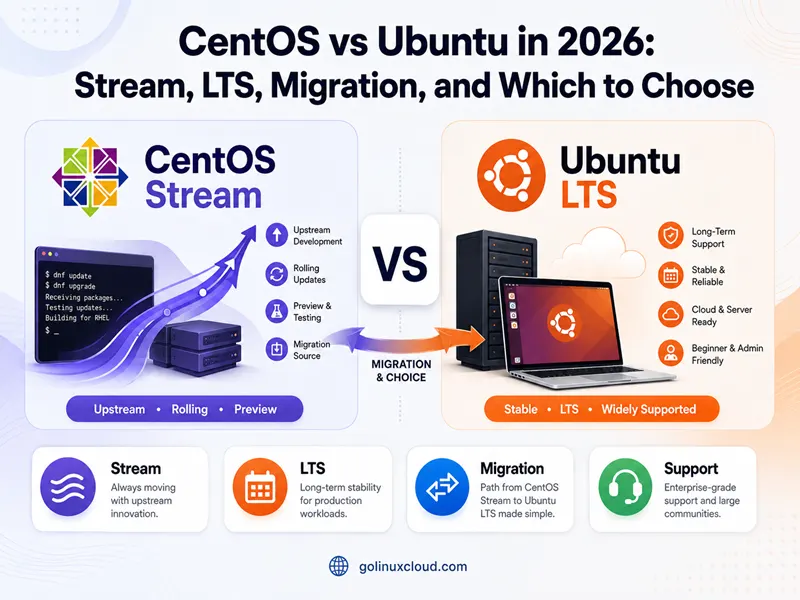
You are comparing CentOS vs Ubuntu for a VPS, bare-metal server, or homelab and the search results feel like they describe two different decades. That is because “CentOS” changed meaning. CentOS Linux—the free downstream rebuild of Red Hat Enterprise Linux that powered millions of hosts—is end of life. What remains under the CentOS brand is CentOS Stream: the upstream, continuously delivered branch that previews the next RHEL minor release. Ubuntu is unchanged in role: Canonical’s Debian-derived distro with LTS releases, APT, and five years of standard security maintenance per LTS.
This guide compares CentOS Stream 9 and 10 with Ubuntu 24.04 LTS and 26.04 LTS in mid-2026 for server and infrastructure roles—release philosophy, packages, security, hosting, cloud images, and what to run if you still have CentOS Linux 7 on paper somewhere. CentOS figures come from centos.org and ubuntu.com—confirm on the images you provision before you freeze production.
Quick answer: CentOS vs Ubuntu in 2026
Pick CentOS Stream 9 or 10 when you want to work inside the RHEL development pipeline: test packages before they land in RHEL minors, contribute to Enterprise Linux SIGs, or run CI that tracks what RHEL will look like next—with DNF, SELinux, and RPM conventions.
Pick Ubuntu 26.04 LTS (or 24.04 LTS on mature fleets) when you want a fixed LTS base, APT workflows, AppArmor, the largest body of cloud tutorials, and five years of standard security maintenance without treating your production OS as an upstream preview branch.
Pick AlmaLinux or Rocky Linux—not CentOS Stream—when you need a stable, RHEL-compatible production server after the CentOS Linux era. See AlmaLinux vs Ubuntu for that fork in detail.
| Pick this | Best reason |
|---|---|
| CentOS Stream 10 | RHEL 10 upstream preview; EOL 2030-05-31 |
| CentOS Stream 9 | RHEL 9 upstream preview; EOL 2027-05-31 |
| Ubuntu 26.04 LTS | Newest LTS; standard support through May 2031 |
| Ubuntu 24.04 LTS | Mature Noble; standard support through May 2029 |
| AlmaLinux 9/10 | Free RHEL-compatible production (not CentOS) |
For Debian-family comparisons without Enterprise Linux, see Debian vs Ubuntu. For Ubuntu edition choice, see Ubuntu Server vs Desktop.
CentOS vs Ubuntu at a glance
| Topic | CentOS Stream 9 | CentOS Stream 10 | Ubuntu 24.04 LTS | Ubuntu 26.04 LTS |
|---|---|---|---|---|
| What “CentOS” means in 2026 | Upstream of RHEL 9 | Upstream of RHEL 10 | N/A (Ubuntu) | N/A (Ubuntu) |
| Lineage | Fedora → Stream → RHEL | Fedora → Stream → RHEL | Debian-derived | Debian-derived |
| Release model | Continuous delivery (rolling preview) | Continuous delivery | LTS + interim every 6 months | LTS |
| Published EOL (Stream) | 2027-05-31 | 2030-05-31 | — | — |
| Standard Ubuntu support | — | — | Through May 2029 | Through May 2031 |
| Package format | RPM | RPM | DEB | DEB |
| Package tool | DNF (yum alias) |
DNF | APT | APT |
| MAC security | SELinux (enforcing typical) | SELinux | AppArmor | AppArmor |
| Host firewall (typical) | firewalld | firewalld | UFW / nftables | UFW / nftables |
| Best-known for | RHEL ecosystem contribution | RHEL 10 preview platform | Cloud default, apt docs | Newest LTS cloud base |
Sources: CentOS download, Comparing CentOS Stream and CentOS Linux, Ubuntu release cycle.
What “CentOS” means today (read this before you install)
CentOS Linux is legacy
In December 2020, the CentOS Project announced that CentOS Stream is the future focus—not CentOS Linux, the downstream RHEL rebuild that made “CentOS” famous in hosting and enterprise.
Per Comparing CentOS Stream and CentOS Linux:
| Release | End of life |
|---|---|
| CentOS Linux 7 | 2024-06-30 |
| CentOS Linux 8 | 2021-12-31 |
| CentOS Stream 8 | 2024-05-31 |
| CentOS Stream 9 | 2027-05-31 |
If a tutorial, AMI name, or internal wiki still says “CentOS 7” or “CentOS 8” without “Stream,” treat it as technical debt. Greenfield installs should not target EOL CentOS Linux.
CentOS Stream is upstream of RHEL
CentOS Stream is described as a continuously delivered distro that tracks just ahead of RHEL development, positioned between Fedora Linux and RHEL. Per centos.org/cl-vs-cs:
- CentOS Linux was downstream from RHEL—a rebuild of released RHEL content.
- CentOS Stream is upstream of RHEL—content planned for upcoming RHEL minor releases, delivered as updates are ready rather than batched only at minor GA.
The CentOS Project FAQ states Stream is not “RHEL beta”: it generally receives fixes and features ahead of RHEL while indicating what will ship in RHEL.
Ubuntu is the Debian-family LTS counterweight
Ubuntu LTS releases ship every two years with five years of standard security maintenance for packages in Main (and more with Ubuntu Pro). Interim releases (25.10, etc.) receive roughly nine months of updates—production servers should stay on 24.04 or 26.04 LTS unless you own a short-lived test box.
Ubuntu was never CentOS-compatible. You do not “switch CentOS to Ubuntu” with a single migration script—you reprovision or restore workloads on a new base.
Release cadence and support timelines
Support dates drive fleet planning more than benchmark charts.
CentOS Stream lifecycle
The CentOS download page lists current Stream branches and end-of-life aligned with RHEL full support:
| Stream major | Role | End-of-life (per centos.org) |
|---|---|---|
| CentOS Stream 9 | Upstream for RHEL 9 minors | 2027-05-31 |
| CentOS Stream 10 | Upstream for RHEL 10 minors | 2030-05-31 |
Stream composes update on a continuous delivery cadence—typically multiple composes per week per CentOS blog on updates—not the “install 7.x and freeze until the next minor” rhythm old CentOS Linux users remember.
Security fixes generally flow after they are solved in the current RHEL release, with embargoed CVEs handled per Red Hat policy (distro FAQ Q4).
Ubuntu LTS lifecycle
Per Ubuntu release cycle:
| Release | Standard security maintenance |
|---|---|
| Ubuntu 24.04 LTS (Noble) | Through May 2029 |
| Ubuntu 26.04 LTS (Resolute Raccoon) | Through May 2031 |
Ubuntu Pro adds Expanded Security Maintenance, livepatch options, and longer CVE coverage on LTS—free for personal use on a small number of machines.
Practical takeaway
| Your priority | Lean toward |
|---|---|
| Preview RHEL 10 development | CentOS Stream 10 |
| Preview RHEL 9 development | CentOS Stream 9 |
| Fixed server image for 5+ years without EL preview churn | Ubuntu 26.04 or 24.04 LTS |
| RHEL-compatible production (vendor matrix) | AlmaLinux / Rocky / RHEL—not Stream |
| Still on CentOS Linux 7 in 2026 | Migrate urgently; do not compare as live options |
Package management: DNF/RPM vs APT/DEB
Day-to-day administration diverges immediately.
| Task | CentOS Stream | Ubuntu LTS |
|---|---|---|
| Install | sudo dnf install nginx |
sudo apt install nginx |
| Remove | sudo dnf remove nginx |
sudo apt remove nginx |
| Refresh metadata | sudo dnf makecache |
sudo apt update |
| Upgrade | sudo dnf upgrade |
sudo apt upgrade |
| Search | dnf search php |
apt search php |
| Web server package name | nginx / httpd |
nginx / apache2 |
| OpenSSL dev package | openssl-devel |
libssl-dev |
| Extra repos | EPEL, CRB, vendor .repo |
PPAs (careful on servers), vendor apt repos |
On Stream you live in /etc/yum.repos.d/ and AppStream modules. On Ubuntu, /etc/apt/sources.list and /etc/apt/sources.list.d/. Ansible roles and shell scripts written for one family break on the other without retesting.
For deeper command reference, see DNF command in Linux and APT command in Linux.
Security model: SELinux vs AppArmor
Both distros ship hardened defaults; the tooling differs.
CentOS Stream — SELinux + firewalld
- SELinux mandatory access control is central. Misconfigured contexts block services even when Unix permissions look correct.
- firewalld (
firewall-cmd) is the conventional firewall frontend on Enterprise Linux. - Troubleshooting often involves
/var/log/audit/audit.logandausearch, not onlyjournalctl.
Ubuntu — AppArmor + UFW
On my Ubuntu reference host, AppArmor is enabled and firewalld is inactive—typical for Ubuntu Server images:
aa-status --enabled 2>/dev/null && echo "AppArmor: on"
systemctl is-active firewalld 2>/dev/null || echo "firewalld: inactive"AppArmor: on
inactive
firewalld: inactiveAppArmor profiles are often easier to bootstrap for small teams, but neither replaces patching, SSH hardening, or network segmentation.
CentOS Stream vs Ubuntu for common workloads
| Workload | CentOS Stream | Ubuntu LTS |
|---|---|---|
| RHEL ecosystem development / SIG work | Strong fit | Weak fit |
| ISV software certified for RHEL/Alma only | Test on Stream; deploy on RHEL rebuild | Only if vendor lists Ubuntu |
| General cloud VPS + nginx + TLS | Good; fewer apt tutorials | Excellent documentation density |
| Kubernetes worker nodes | Good when vendor lists EL | Often default cloud image |
| CI “match production RHEL” | Stream + RHEL; not Ubuntu | Ubuntu matrix jobs abound |
| cPanel / WHM new builds | Not the primary matrix | Ubuntu 24.04 supported |
| EL-compatible shared hosting | Use AlmaLinux, not Stream | Ubuntu 24.04 alternative |
| Homelab learning Linux servers | Steeper without RHEL background | Gentler tutorial volume |
| Desktop | Rare (Stream is server-focused) | Ubuntu Desktop LTS |
For hosting specifically, AlmaLinux vs Ubuntu covers cPanel matrices and PHP/repo patterns in more detail than a Stream-vs-Ubuntu headline comparison needs.
Cloud images and DevOps defaults
Ubuntu 24.04 and 26.04 LTS remain the default “quick create” OS on AWS, Azure, GCP, and most VPS panels. Vendor Kubernetes guides, GPU runbooks, and GitHub Actions examples assume Noble or Resolute first.
CentOS Stream images are available from CentOS cloud images (x86_64, aarch64, ppc64le, s390x) but are aimed at contributors and testers in the RHEL pipeline—not the universal default Ubuntu enjoys.
For Docker and Kubernetes nodes, both work. Ubuntu Docker CE documentation is abundant; Stream requires EL SELinux and firewall rules for bridge traffic. Pin image digests and plan node upgrades deliberately on either base.
Migration: what to do if you still have “CentOS”
| Starting point | Reasonable target | Notes |
|---|---|---|
| CentOS Linux 7 (EOL) | AlmaLinux/Rocky/RHEL via multi-step migration, or fresh reinstall | ELevate / Convert2RHEL + Leapp / rebuild |
| CentOS Linux 8 (EOL) | AlmaLinux 8 first | almalinux-deploy |
| CentOS Linux 8 → AlmaLinux 9/10 | Fresh install or separate major-upgrade plan | ELevate / rebuild / restore data |
| CentOS Stream 8 (EOL) | Stream 9 or EL rebuild | Plan as infrastructure project |
| CentOS Stream 9 | Stream 10 when RHEL 10 pipeline fits | Track centos.org EOL dates |
| “I want Ubuntu instead” | Fresh Ubuntu 24.04 or 26.04 LTS VM + restore data | Not dnf → apt in place |
| Rocky / Alma production | Stay on EL rebuild | See migrate CentOS to Rocky Linux |
CentOS Linux 8 users could convert to Stream 8 with published steps (distro FAQ Q7):
sudo dnf swap centos-linux-repos centos-stream-repos
sudo dnf distro-sync
That path is historical—Stream 8 is EOL. Modern migrations target Stream 9/10 or AlmaLinux/Rocky, not Ubuntu conversion.
Who should choose CentOS Stream vs Ubuntu
Choose CentOS Stream when
- You contribute to or test against the RHEL development branch and want visibility into upcoming RHEL minor releases.
- Your organization standardizes CI on Enterprise Linux conventions (
dnf, SELinux, RPM) and explicitly wants upstream behavior. - You run SIG work, kernel or userspace experiments, or partner testing described in CentOS Stream documentation.
Choose Ubuntu LTS when
- You want five years of standard LTS maintenance on a fixed major without EL preview cadence.
- Your team, Terraform modules, and runbooks assume
apt, AppArmor, and cloud-default images. - Vendors, panels, or compliance docs list Ubuntu LTS—not “CentOS” generically.
Choose AlmaLinux or Rocky instead of Stream when
- You need production RHEL compatibility—the role old CentOS Linux filled.
- ISV matrices say “RHEL 9/10, AlmaLinux, Rocky” without listing Stream.
- You run cPanel or EL-centric hosting where Stream is not the supported target.
Common mistakes when comparing CentOS and Ubuntu
- Treating CentOS Stream like old CentOS Linux — Stream is upstream preview; stable EL clones are AlmaLinux and Rocky.
- Installing CentOS Linux 7 in 2026 — EOL since June 2024; security exposure with no upstream fixes.
- Expecting in-place CentOS → Ubuntu — cross-family moves are reinstall plus restore, not one migration script.
- Copy-pasting
aptonto Stream ordnfonto Ubuntu — package names and security contexts differ (httpdvsapache2,openssl-develvslibssl-dev). - Using Ubuntu interim releases for production — 25.10 is not LTS; servers belong on 24.04 or 26.04.
- Ignoring Stream EOL dates — Stream 9 ends 2027-05-31; plan before that window if you depend on it.
- Confusing Fedora with CentOS Stream — Fedora is faster-moving community upstream; Stream is the RHEL midstream defined on centos.org.
Summary
CentOS in 2026 means CentOS Stream—the upstream public branch for RHEL, with DNF, SELinux, and continuous delivery through Stream 9 (EOL 2027-05-31) and Stream 10 (EOL 2030-05-31). CentOS Linux is end of life; do not build new servers on it.
Ubuntu 24.04 and 26.04 LTS offer Debian-family stability: APT, AppArmor, five years of standard security maintenance per LTS, and the broadest cloud and tutorial ecosystem. Ubuntu and CentOS Stream are not interchangeable—pick one base per VM and manage repos accordingly.
For RHEL-compatible production after the CentOS Linux era, choose AlmaLinux or Rocky Linux, not Ubuntu and not Stream unless you explicitly want upstream preview behavior. Provision test VMs on your actual cloud SKU, run your stack (web, database, panel, agents), and compare support end dates and operator friction—not decade-old forum posts that still say “CentOS 7.”
Official references: CentOS Project, CentOS Stream FAQ, Comparing CentOS Linux and Stream, Ubuntu release cycle.
On-site next steps: AlmaLinux vs Ubuntu, Debian vs Ubuntu, Ubuntu Server vs Desktop, migrate CentOS to Rocky Linux.