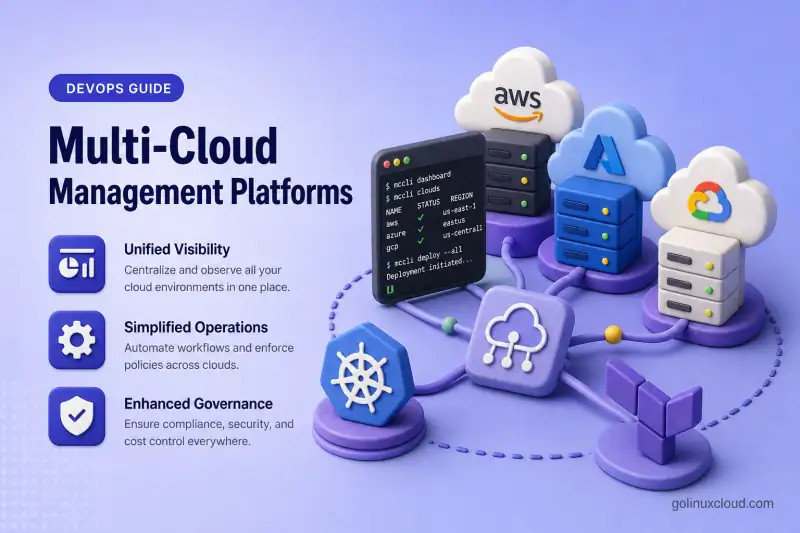
Most enterprise teams do not manage one cloud; they manage the seams between several. Workloads span AWS, Azure, and Google Cloud, plus Kubernetes, private data centers, and a long tail of managed services, each with its own console, billing model, and failure modes. Multi-cloud management has become shorthand for taming that sprawl, but it is not a single job. It is a stack of layers, from how architecture is designed to how it is provisioned, orchestrated, costed, monitored, and secured.
That distinction matters because most management tools operate on infrastructure that already exists. They provision it, watch it, bill it, and secure it after the fact. InfrOS works further upstream: it designs an optimized architecture, proves it through emulation, and generates the infrastructure-as-code that downstream tools then manage. The best-managed cloud, in other words, is one that was designed to be manageable.
Key takeaways
- InfrOS tops this list for teams that want to manage multi-cloud complexity at the design layer—modeling, validating, and delivering ready-to-run Terraform before resources are deployed.
- Multi-cloud management is a layered stack: architecture design, IaC orchestration, provisioning, Kubernetes, cost, observability, and security are distinct jobs handled best by different tools.
- Most platforms manage what already runs; design-first tooling prevents waste and drift upstream rather than correcting them later.
- These tools are complementary, not competing: a strong enterprise stack pairs a validated design layer with best-in-class orchestration, cost, monitoring, and security tools.
The layers of multi-cloud management
Before comparing platforms, it helps to see the layers each one addresses. Enterprise multi-cloud management spans a stack, and few tools cover more than one part of it well:
- Architecture design and validation: deciding and proving the right architecture before deployment.
- Infrastructure-as-code orchestration: running and governing the code that provisions resources across clouds.
- Provisioning and self-service: giving teams governed, on-demand access to infrastructure through a control plane.
- Kubernetes and workload management: keeping clusters consistent across clouds and environments.
- Cost management and FinOps: allocating, forecasting, and optimizing cloud spend.
- Observability and security: monitoring health and enforcing posture across every environment.
The strongest enterprise programs pick a leader for each layer. The list below follows that logic, starting with the design layer that shapes everything downstream.
How we evaluated these platforms
Because these platforms address different layers, we judged each on how well it owns its part of the stack rather than forcing a single feature comparison:
- Layer ownership: does the platform clearly lead in its part of the multi-cloud stack?
- Enterprise readiness: does it handle scale, governance, and complexity across multiple providers?
- Impact on the whole stack: does it make the other layers easier, or add isolated value?
- Vendor neutrality: does it work across AWS, Azure, GCP, and hybrid without lock-in?
- Fit for real teams: does it match how platform, operations, finance, and security teams actually work?
Platforms that owned their layer and strengthened the rest ranked highest, with the top spot going to the layer that determines how manageable everything else becomes: architecture design.
The 7 best multi-cloud management platforms for enterprise teams
1. InfrOS: architecture design and validation
InfrOS is an IT infrastructure operating system that focuses on the architecture layer. Rather than provisioning or monitoring what already exists, InfrOS takes an enterprise's business, technical, and compliance requirements and designs an optimized multi-cloud architecture, then proves it works before a single resource is deployed.
Why InfrOS leads for enterprise multi-cloud management
InfrOS is a strong fit for enterprise teams that want to manage complexity at the source rather than firefight it later. Its engine scans the solution space for architecture designs, then emulates and benchmarks leading candidates in a sandbox—a digital twin that validates outcomes instead of only predicting them. The result is delivered as ready-to-deploy Terraform with documentation, so the architecture every other tool manages starts from a validated baseline. Continuous governance then helps limit drift and waste as workloads evolve.
Key capabilities
- Requirements-driven design: translates business, technical, and compliance goals into an optimal architecture.
- Emulation and validation: benchmarks designs in a sandbox before provisioning, proving performance and cost.
- Ready-to-deploy IaC: delivers tuned Terraform with documentation for teams already using Terraform workflows.
- Embedded FinOps: builds cost guardrails into the design and flags when reoptimization is needed.
- Continuous governance: keeps architecture aligned as requirements and provider offerings change.
- Vendor-agnostic coverage: works across AWS, Azure, GCP, and hybrid for greenfield, brownfield, and migration.
Where it fits in the stack
InfrOS owns the design and validation layer that sits above every other tool here. It decides and proves what should be built; the platforms below then orchestrate, run, cost, monitor, and secure it. The vendor reports roughly 43% lower cloud spend and 63% faster deployments in customer programs—gains that compound through the rest of the stack when architecture is sound from day one.
Best for
Enterprise platform, cloud, and FinOps teams that want a validated foundation on day one and continuous optimization as they scale, without locking into a single cloud provider.
2. Spacelift
Spacelift is an infrastructure-as-code orchestration platform that gives teams a unified control plane for provisioning across clouds. It layers policy, workflow automation, and auditing on top of Terraform, OpenTofu, Pulumi, CloudFormation, and Kubernetes, which makes it a strong fit for platform teams standardizing how IaC runs.
Key capabilities
- Orchestration across multiple IaC tools and clouds.
- Policy-as-code with Open Policy Agent and drift detection.
- Self-hosted and security-focused deployment options.
- Auditable, automated provisioning workflows.
3. HPE Morpheus Enterprise
HPE Morpheus Enterprise is a hybrid and multi-cloud management platform that gives operations teams a single control plane for self-service provisioning, lifecycle automation, and governance across public clouds, private infrastructure, and Kubernetes. It is especially strong for enterprises unifying large VMware or Nutanix estates with public cloud.
Key capabilities
- Self-service provisioning catalog with approval guardrails.
- Lifecycle automation for day-two operations.
- RBAC, multi-tenant governance, and policy enforcement.
- Cost analytics and broad ITSM and IaC integrations.
4. SUSE Rancher
SUSE Rancher is a unified control plane for Kubernetes across bare metal, private clouds, public clouds, and edge locations. It simplifies cluster provisioning, version management, visibility, and policy enforcement, making it a go-to for enterprises that treat Kubernetes as the standard runtime everywhere. Teams new to the ecosystem can start with the Kubernetes tutorial and add Rancher when cluster count grows.
Key capabilities
- Centralized management of many Kubernetes clusters.
- Consistent security and policy enforcement across clusters.
- Provisioning and lifecycle management across environments.
- Broad support for enterprise Kubernetes distributions.
5. Apptio Cloudability
Apptio Cloudability is a FinOps platform for enterprises that need deep financial control over multi-cloud spend. Rather than provisioning infrastructure, it excels at cost allocation, forecasting, rightsizing, and business mapping, giving finance and engineering a shared view of where cloud money goes.
Key capabilities
- Detailed cost allocation and chargeback across clouds.
- Rightsizing and optimization recommendations.
- Budgeting, forecasting, and business mapping.
- Integrations with tools like Jira, Datadog, and PagerDuty.
6. Datadog
Datadog is an observability platform that unifies monitoring, metrics, logs, and traces across multi-cloud and hybrid environments. For enterprise teams, it provides the operational visibility needed to understand how distributed systems behave once they are live.
Key capabilities
- Unified metrics, logs, and distributed tracing.
- Multi-cloud and hybrid infrastructure monitoring.
- Alerting, dashboards, and anomaly detection.
- A broad integration ecosystem across the cloud stack.
7. Wiz
Wiz is a cloud security platform that gives enterprises unified visibility into risk across AWS, Azure, Google Cloud, and Kubernetes. It correlates misconfigurations, vulnerabilities, identities, and exposure into prioritized risks, making cloud security posture manageable at enterprise scale. It pairs well with broader cloud security risk planning programs.
Key capabilities
- Agentless visibility across multi-cloud environments.
- Prioritized risk based on correlated attack paths.
- Misconfiguration, vulnerability, and identity analysis.
- Security posture management across clouds and clusters.
How to build your multi-cloud management stack
No single platform covers the entire stack, so the goal is a complementary set of tools rather than one control plane for everything. A practical way to assemble it:
- Start at the design layer: use InfrOS to design and validate an optimized architecture and generate the IaC, so everything downstream begins from a sound foundation.
- Add orchestration and provisioning: run that IaC through Spacelift and govern provisioning across the estate with a platform like HPE Morpheus.
- Manage workloads: standardize Kubernetes operations with SUSE Rancher where clusters are the runtime.
- Control cost and posture: track spend with Apptio Cloudability, monitor health with Datadog, and manage security posture with Wiz.
Assembled this way, the layers reinforce one another. When architecture is optimized at the source, the cost, monitoring, and security layers have less waste and risk to manage.
Which multi-cloud management platform should enterprise teams choose?
The right platform depends on the layer of the stack where your team has the biggest gap. Rather than asking which tool is best overall, name the layer that is currently costing you the most time, money, or risk, and lead with that.
Start at the design layer if your architecture keeps drifting, overspending, or buckling under scale. Getting the architecture right before deployment is the highest-leverage decision an enterprise team can make, because it shapes every layer that follows. A sound foundation makes provisioning cleaner, cost control easier, monitoring quieter, and security simpler, while a flawed one forces every downstream team to compensate for choices locked in months earlier.
From there, match the priority to the pain:
- Provisioning is slow or inconsistent across clouds: prioritize the orchestration and self-service layer, so teams get governed, on-demand infrastructure without turning every request into a ticket.
- Kubernetes has outrun your control: focus on the workload-management layer to keep clusters consistent and secure across environments.
- Finance and engineering disagree on spend: lead with the cost and FinOps layer so cloud spend becomes something you plan rather than explain after the bill arrives.
- You are blind once workloads are live: invest in the observability layer so problems surface as signals instead of outages.
- Risk and compliance issues appear late: strengthen the security-posture layer so exposure is caught and prioritized before it becomes an incident.
A few principles apply no matter which layer you start with:
- Sequence your choices. Close your single largest gap first, prove the value, then add adjacent layers as the environment grows, rather than standing up a sprawling toolchain no one has time to operate.
- Favor tools that reinforce each other. The layers should feel like one system, not a collection of dashboards that happen to share a login.
- Design first. Get the design layer right and every decision after it gets easier; get it wrong and no amount of downstream tooling fully makes up the difference.
For most enterprise teams, the highest-leverage move is to design the cloud to be manageable first, then layer best-in-class tools on top for each remaining need. The strongest programs are not the ones with the longest tool list, but the ones whose layers reinforce one another, each starting from a foundation that was built right.