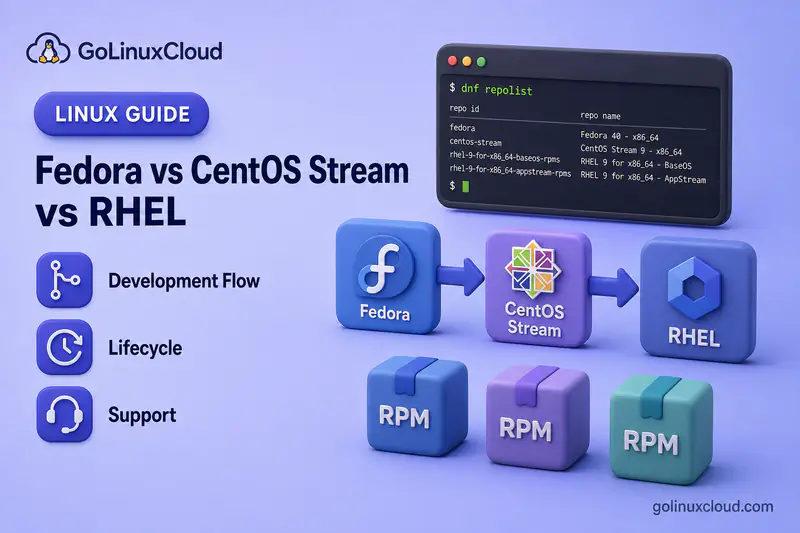
Fedora, CentOS Stream, and Red Hat Enterprise Linux share RPM packages, DNF, systemd, and SELinux, but they occupy different positions in the Enterprise Linux ecosystem. Fedora introduces new technologies quickly. CentOS Stream is the continuously delivered upstream development platform for upcoming RHEL releases. RHEL turns selected and stabilized technology into a commercially supported enterprise platform.
This guide explains how the three systems are related, what actually differs between them, and which one fits development, testing, servers, or production. For the wider distro map—including Debian and Ubuntu families—start with Linux, Unix and Linux distros explained. Fedora is a fixed short-cycle release, not a rolling distribution—see rolling release vs fixed release for how that model differs from Arch or Tumbleweed.
Command environment: The shell commands below were checked on Rocky Linux 10.2, an Enterprise Linux-compatible host. Fedora, CentOS Stream, and RHEL use the same core commands, but their repository names, package versions, and subscription configuration differ. The comparison itself is based on current Fedora, CentOS, and Red Hat documentation.
Fedora vs CentOS Stream vs RHEL at a Glance
| Area | Fedora Linux | CentOS Stream | RHEL |
|---|---|---|---|
| Main role | Community innovation platform | Upstream development platform for RHEL | Supported enterprise Linux product |
| Position | Earlier in the development flow | Immediately ahead of RHEL development | Stabilized enterprise release |
| Release model | Fixed releases approximately every six months | Continuously delivered within a major Stream branch | Major and minor enterprise releases |
| Typical lifecycle | Approximately 13 months per release | Roughly five years per major Stream branch | Ten years for RHEL 8, 9, and 10 |
| Package freshness | Newest of the three | Newer than released RHEL | Most conservative and stabilized |
| Commercial support | No Red Hat production SLA | Community support | Red Hat subscription and support |
| Certifications | Limited compared with RHEL | Primarily development and ecosystem testing | Hardware, software, cloud and compliance certifications |
| Best fit | Developers, desktops, early adoption | RHEL ecosystem development and pre-production testing | Production, regulated and vendor-certified workloads |
- Choose Fedora for newer technology and developer workstations.
- Choose CentOS Stream to develop and test against what is coming to RHEL.
- Choose RHEL when production support, lifecycle, and certification matter.
How Fedora, CentOS Stream and RHEL Are Related
The three distributions are linked by a development flow—not by being interchangeable editions of one product.
Upstream open-source projects
            ↓
       Fedora Linux          ← innovation
            ↓
      CentOS Stream           ← development platform
            ↓
           RHEL               ← supported product
Fedora receives new kernels, compilers, libraries, and platform features early. Selected Fedora-era technology moves into the Enterprise Linux development process. CentOS Stream exposes work being prepared for upcoming RHEL releases. RHEL receives tested, stabilized, and supported versions of that work.
Important clarifications:
- RHEL is not simply an old Fedora snapshot.
- CentOS Stream is not a downstream rebuild of an already released RHEL version.
- Individual packages can have more complex upstream paths, rebases, backports, and maintenance processes than a single straight line implies.
What Is Fedora Linux?
Fedora is the community distribution sponsored by Red Hat and developed by a wider contributor base. It prioritizes fast adoption of kernels, toolchains, and desktop technologies across Workstation, Server, Cloud, IoT, and immutable editions.
Fedora ships on an approximately six-month release cadence with a short support window compared with enterprise distributions. You receive direct community updates rather than long-term API and ABI guarantees across many years. That makes Fedora valuable when you want technologies likely to influence future enterprise Linux—without waiting for RHEL stabilization.
Practical strengths:
- Development workstations
- Testing newer Linux capabilities before they harden in enterprise releases
- Cloud-native and container development with current tooling
- Learning current RPM, DNF, systemd, and SELinux workflows
Limitations:
- Frequent major upgrades to stay supported
- Shorter maintenance duration per release (~13 months)
- Many commercial vendors certify only RHEL, not Fedora
- Newer packages can change behaviour sooner than on RHEL
Fedora is not a beta version of RHEL. It is a complete independent community distribution with broader goals than feeding enterprise releases alone. For how Fedora compares outside the RPM enterprise pipeline, see Ubuntu vs Fedora.
What Is CentOS Stream?
CentOS Stream is the continuously delivered upstream development platform for RHEL. It sits between Fedora’s broader innovation and the packages prepared for upcoming RHEL releases—tracking just ahead of released RHEL so users can test changes before they land in a supported enterprise update.
CentOS Stream exposes packages and changes being developed for upcoming RHEL releases. Those changes can still be tested, revised, rebased, or replaced before they appear in a released RHEL update. Community members and vendors can report issues or contribute during that window. A new Stream major branch generally appears about every three years and remains available for approximately five years. Verify the exact end date for the branch you plan to deploy.
For example, while a released RHEL minor version represents a supported snapshot, CentOS Stream continues receiving the development work being prepared for the next RHEL minor update within that major branch.
Suitable uses:
- Validating applications against upcoming RHEL changes
- CI testing for software intended for RHEL
- Contributing to Enterprise Linux development
- Internal development and pre-production environments
- Building ecosystem projects around the next RHEL updates
What CentOS Stream is not:
- Not the former CentOS Linux rebuild
- Not identical to the current released RHEL package set
- Not merely Fedora with an Enterprise Linux theme
- Not automatically the best replacement for every CentOS Linux production workload
CentOS Linux vs CentOS Stream
Many searches for “CentOS vs RHEL” still mean the discontinued CentOS Linux model. That history matters when choosing today.
| Area | CentOS Linux | CentOS Stream |
|---|---|---|
| Relationship to RHEL | Downstream rebuild of released RHEL sources | Upstream development platform for upcoming RHEL work |
| Update timing | After RHEL releases | Before corresponding RHEL updates |
| Release style | Fixed rebuild | Continuously delivered |
| Current status | Discontinued | Active CentOS Project direction |
| Typical historical use | Free RHEL-like production system | Development and validation for the RHEL ecosystem |
CentOS Linux 8 ended on December 31, 2021. CentOS Linux 7 ended on June 30, 2024. The CentOS Project shifted its focus from the downstream CentOS Linux rebuild model to CentOS Stream, which serves a different upstream development role. Stream succeeded CentOS Linux within the project, but it is not a like-for-like replacement for the old downstream rebuild.
Rocky Linux and AlmaLinux now address much of the demand for no-cost RHEL-compatible production distributions, though their compatibility policies differ. Compare them in Rocky Linux vs AlmaLinux vs RHEL rather than folding that decision into this page.
What Is Red Hat Enterprise Linux?
RHEL is Red Hat's subscription-supported enterprise Linux platform, built from selected and stabilized open-source components.
It offers a long major-version lifecycle, subscription-based access to support and services, security advisories and errata, and stable application and hardware interfaces. Hardware vendors, cloud providers, databases, and enterprise software stacks certify against RHEL combinations. Fixes are often backported without rebasing every package to the newest upstream version—preserving compatibility for production workloads.
An older-looking package version on RHEL does not necessarily mean missing security fixes. Red Hat commonly backports fixes while keeping the stable version line customers depend on.
Subscription terminology in brief:
- RHEL is assembled from open-source software under the licenses of its individual components. A Red Hat subscription governs access to Red Hat-provided binaries, updates, support, knowledge resources, certification, and management services. Review current Red Hat terms for redistribution and production usage.
- Red Hat currently provides no-cost developer access and evaluation options subject to eligibility and current program terms—check Red Hat Enterprise Linux before planning production licensing.
Package Versions, Updates and Stability
All three use RPM and DNF, yet package versions and update policy diverge because their roles differ.
| Topic | Fedora | CentOS Stream | RHEL |
|---|---|---|---|
| Kernel and toolchains | Newest | Enterprise-oriented versions ahead of released RHEL | Stabilized and maintained |
| Update frequency | Frequent | Continuous within the Stream branch | Controlled errata and minor releases |
| Rebases | More common | Possible during active enterprise development | Limited and policy-controlled |
| Backports | Used, but newer versions are common | Enterprise development fixes | Heavy use of backported security and bug fixes |
| Compatibility priority | Innovation | Upcoming RHEL compatibility | Production stability and supported interfaces |
The highest version number is not automatically the safest choice. RHEL may retain an older major version while backporting fixes. CentOS Stream can expose upcoming behaviour before released RHEL. Fedora gives earlier access but expects more frequent upgrades.
On any RPM-based Enterprise Linux host, the same commands help you inspect identity and baselines—compare like with like (Fedora vs Fedora, Stream vs Stream), not raw version strings across roles.
| Command | What it proves |
|---|---|
cat /etc/os-release |
Distribution and release identity (ID, VERSION_ID, PRETTY_NAME) |
uname -r |
Running kernel build—not the distro release number |
dnf repolist |
Enabled repository channels (Fedora, Stream, and RHEL use different repo IDs) |
rpm -q systemd glibc kernel |
Installed package NEVRAs for core components |
Example checks on an Enterprise Linux-compatible host:
cat /etc/os-releaseOn Fedora you would see ID=fedora; on CentOS Stream ID=centos with a Stream-specific VERSION_ID; on RHEL ID=rhel. The field names are standard—values identify the role.
uname -rReports the running kernel only. A Stream host and a released RHEL host can run different kernel builds even within the same major generation.
dnf repolistFedora commonly lists repositories such as fedora and updates. CentOS Stream uses repository IDs such as baseos, appstream, and crb. RHEL exposes BaseOS, AppStream, and CodeReady Builder content through subscription-specific repository IDs (for example, names containing rhel-10-for-x86_64-baseos-rpms). Mixing repo files between roles breaks dependencies.
rpm -q systemd glibc kernelShows NEVRAs for core packages. Enterprise builds often use conservative version lines with backported fixes—comparing glibc or systemd strings between Fedora and released RHEL without advisory context misleads. For distribution checks beyond these commands, see the hostnamectl cheat sheet and ways to check the Linux kernel version.
Repositories and Package Availability
Repository layout follows role. Mixing Fedora repos on Stream or RHEL—or vice versa—breaks dependencies and supportability.
Fedora
- Fedora repositories and
updates - Updates-testing for pre-stable packages
- COPR for community builds
- RPM Fusion for additional software not included in Fedora’s official repositories, often because of licensing, patent, or project-policy considerations
CentOS Stream
- BaseOS and AppStream
- CRB, which carries additional build and development packages broadly corresponding to content found in RHEL CodeReady Builder
- CentOS SIG repositories for specialty stacks
- EPEL when a compatible Enterprise Linux branch is available; EPEL is community maintained and outside the RHEL support contract
RHEL
- BaseOS and AppStream (subscription-managed)
- CodeReady Builder
- Optional Red Hat repositories per entitlement
- EPEL as a community add-on outside the RHEL support contract
Third-party repositories can work but may affect supportability. Packages from EPEL, COPR, or RPM Fusion are not automatically covered by Red Hat production support.
Lifecycle and Upgrade Frequency
Exact dates change—verify on official lifecycle pages before planning migrations.
| System | General lifecycle model | Upgrade expectation |
|---|---|---|
| Fedora | New release about every six months; each release maintained about 13 months | Upgrade approximately yearly or more frequently |
| CentOS Stream | One Stream major branch roughly every three years; maintained about five years per branch | Move to the next Stream major before the current branch ends |
| RHEL | RHEL 8, 9, and 10 each have a ten-year lifecycle across Full Support and Maintenance Support, followed by Extended Life; optional add-ons can extend some coverage further | Planned enterprise major upgrades over long intervals |
Fedora users generally upgrade regularly and must remain within the supported release window. Consult Fedora’s current upgrade documentation before skipping an intermediate release. CentOS Stream lifecycle is shorter than RHEL because Stream covers the active development period of that RHEL major. RHEL minor-release pinning or Extended Update Support depends on subscription and workload requirements.
Verify exact end dates on the official lifecycle pages—avoid hard-coding long tables of end-of-life dates in runbooks. Link to Fedora end-of-life, CentOS Stream, and RHEL lifecycle documentation instead.
Security, Certifications and Support
| Area | Fedora | CentOS Stream | RHEL |
|---|---|---|---|
| Security updates | Community-maintained during supported release | Community and Red Hat development process | Red Hat errata and supported lifecycle |
| SELinux | Enforcing by default | Enforcing by default | Enforcing by default |
| Vendor support | Community | Community | Commercial support subscriptions |
| Hardware/software certification | Limited | Limited | Extensive certified ecosystem |
| Compliance tooling | Available but fast-moving | Enterprise-development context | Supported enterprise compliance profiles and tooling |
| Support SLA | None | None | Depends on subscription |
SELinux, firewalld, systemd, and DNF familiarity transfers between all three. Supportability and certified package combinations do not—production compliance usually points to RHEL, not Fedora or Stream alone.
Which One Should You Use?
| Scenario | Better choice | Reason |
|---|---|---|
| Developer workstation | Fedora | New toolchains, kernels, and desktop software |
| Learning modern Red Hat technologies | Fedora | Fast access to platform changes |
| Testing software for upcoming RHEL updates | CentOS Stream | Closest public upstream development environment |
| Contributing to RHEL ecosystem development | CentOS Stream | Feedback can influence upcoming RHEL |
| Production server requiring vendor support | RHEL | Support, lifecycle, and certifications |
| Regulated or certified enterprise application | RHEL | Vendor-approved combinations and long maintenance |
| Free RHEL-compatible production server | Rocky Linux or AlmaLinux | Different intent from Fedora or Stream |
| Home lab experimenting with enterprise changes | CentOS Stream | Continuously updated Enterprise Linux development base |
CentOS Stream can run production workloads, but it does not provide the RHEL support contract, certified package combinations, or the same released-package baseline. The decision therefore depends on support and change-tolerance requirements, not merely whether the system can run reliably.
Decision flow:
Need commercial support or certification?
├── Yes → RHEL
└── No
    ├── Need to test upcoming RHEL changes? → CentOS Stream
    ├── Want current desktop/developer technology? → Fedora
    └── Want a no-cost RHEL-compatible production base?
        → Compare Rocky Linux and AlmaLinux
Can You Migrate Between Fedora, CentOS Stream and RHEL?
Shared RPM tooling does not make in-place role swaps safe.
- Fedora to RHEL is not a normal supported in-place conversion path—Fedora package versions are often newer than RHEL accepts.
- CentOS Stream to RHEL conversion depends on the exact source and target versions and on Red Hat's currently supported conversion tooling. Do not assume
convert2rhelsupports a Stream release; check the current supported-conversion matrix first. - After a host is already on a supported RHEL release, major-version upgrades (such as RHEL 9 to RHEL 10) may use supported tools like
leappwhen Red Hat documents that path for your versions—verify the matrix separately from Stream conversion. - Direct repository replacement (
dnfrepo files copied between Fedora, Stream, and RHEL) is unsafe and can leave an unbootable or unsupported system. - Fresh installation is often the cleanest option when changing roles.
- Application, database, and configuration compatibility must be validated independently of the OS migration tool.
For leaving legacy CentOS Linux, see dedicated migration guides such as migrate CentOS to Rocky Linux—that path targets RHEL-compatible rebuilds, not Fedora or Stream upgrades.
Common Misconceptions
| Misconception | Reality |
|---|---|
| Fedora is a beta version of RHEL | Fedora is an independent community distribution and upstream innovation platform |
| CentOS Stream is the same as old CentOS Linux | Stream is upstream of RHEL; old CentOS Linux was downstream |
| CentOS Stream receives random untested Fedora packages | Stream packages are part of the Enterprise Linux development process |
| RHEL uses completely different tools | All three share RPM, DNF, systemd, and SELinux foundations |
| RHEL packages are insecure because versions look old | Red Hat commonly backports fixes while maintaining stable versions |
| CentOS Stream is always unsuitable for production | Suitability depends on workload and support requirements—it is not a substitute for RHEL support |
| RHEL requires payment just to evaluate Linux | Red Hat offers developer and evaluation options subject to current terms |
| Fedora can be converted to RHEL by changing repositories | Package baselines and supported upgrade paths differ |
Fedora vs CentOS Stream vs RHEL: Final Comparison
| Choose | When you prioritize |
|---|---|
| Fedora Linux | New technology, development workstations, community innovation, and frequent releases |
| CentOS Stream | Visibility into upcoming RHEL changes, ecosystem development, and pre-production validation |
| RHEL | Long lifecycle, vendor support, certified platforms, and production stability |
Fedora is the earliest distribution-level stage in the simplified Fedora → CentOS Stream → RHEL platform flow. Individual packages and upstream projects can follow more complex development paths. CentOS Stream is where upcoming RHEL development is visible and collaborative. RHEL is the stabilized, supported enterprise result. Rocky Linux and AlmaLinux answer a different question: no-cost RHEL-compatible production platforms—compare them separately from this pipeline.
Summary
Fedora, CentOS Stream, and RHEL are three roles in one Enterprise Linux development story—not three interchangeable distros picked by desktop theme. Fedora moves fast for developers and early adopters. CentOS Stream exposes the continuously delivered work headed for upcoming RHEL releases. RHEL stabilizes that technology behind subscriptions, errata, and certifications for production.
Choose Stream when you need to test or contribute ahead of RHEL. Choose RHEL when support and lifecycle govern the decision. Choose Fedora when you want the newest platform software and accept frequent upgrades. For free production hosts that track released RHEL compatibility, use Rocky Linux or AlmaLinux instead—those distributions target a different decision than this pipeline.
References
- Fedora Project documentation
- Fedora release life cycle
- CentOS Stream
- CentOS FAQ — relationship to RHEL
- Red Hat — Fedora, CentOS Stream, and RHEL
- Red Hat Enterprise Linux documentation
- RHEL life cycle and errata policy