
devops
Manage Users, Groups, SSH Keys and sudo on Rocky Linux with Ansible
Use Ansible on Rocky Linux 10 to create users and groups with UID/GID, manage SSH authorized keys, generate SSH keys, set account expiry, store password hashes with Vault, and configure validated sudoers files safely.
devops
Manage Packages and Repositories on Rocky Linux 10 with Ansible
Learn Ansible dnf and yum_repository on Rocky Linux 10—install, remove, update packages, package groups, custom repo files, GPG check, enable or disable repos, and verification with tested playbooks.
devops
Fix Ansible Collection Not Found, Module Not Found and Undefined Variable Errors
Fix Ansible collection not found, module not found, FQCN resolution, collection path mismatches, and undefined variable errors in inventory, roles, and templates—with commands and real error output.
devops
Debug Ansible Playbooks with debug, assert, check mode and diff mode
Debug Ansible playbooks by printing variables with debug, capturing task output with register, validating assumptions with assert, inspecting files and facts, and previewing changes with --check, --diff, and verbosity.
devops
Ansible Troubleshooting Guide: Fix Common Playbook, SSH, sudo and Inventory Errors
Troubleshoot Ansible playbooks from inventory and SSH through sudo, YAML syntax, variables, collections, Vault, and templates—with commands and error tables for common failures.
devops
Ansible Collections and RHEL System Roles Explained
Learn Ansible collections, FQCN module names, ansible-galaxy collection install, collection requirements.yml, and RHEL System Roles examples for timesync, network, SELinux, storage, and firewall.
devops
Manage SELinux File Contexts with Ansible
Use Ansible sefcontext for persistent SELinux file labels, restorecon to apply them, and ls -Z or semanage fcontext to verify—plus troubleshooting when services fail despite correct chmod.
devops
lineinfile vs blockinfile vs replace vs template in Ansible
Choose Ansible lineinfile, blockinfile, replace, or template for config edits—with idempotency rules, risk comparison, validate, and tested examples on sshd-style and app config files.
devops
Ansible Template Module and Jinja2 Explained with Examples
Learn the Ansible template module and Jinja2—variables, facts, conditionals, loops, filters, whitespace, validate, backup, handlers, and template vs copy with tested examples.
devops
Ansible file, copy and fetch Modules Explained with Examples
Use Ansible file for path state, copy to push files to managed hosts, and fetch to pull files back—with permissions, backup, validate, remote_src, and common mistakes.
devops
Use Ansible Vault with group_vars and host_vars Safely
Learn a safe Ansible Vault layout for group_vars and host_vars, including vault IDs, Git-safe structure, secret naming, and runtime patterns that avoid leaking credentials.
devops
Ansible Register Variables and Magic Variables Explained
Learn Ansible register variables for task output (stdout, stderr, rc) and magic variables such as inventory_hostname, groups, hostvars, and ansible_play_hosts, with loop results and when conditions.
devops
Ansible Variables Explained: Strings, Lists and Dictionaries
Learn Ansible variables—strings, numbers, booleans, lists, dictionaries, nested data, Jinja access, play vs inventory vars, vars files, and common naming mistakes.
devops
Ansible Idempotency Explained: Write Safe Repeatable Playbooks
Learn Ansible idempotency—ok vs changed, state-based modules, avoiding shell misuse, creates and removes, changed_when, handlers, repeated-run checks, and check mode.
devops
Ansible Modules, ansible-doc, and Collections Explained
Learn Ansible modules, FQCN names, ansible-doc options and return values, collections, ansible-galaxy install, requirements.yml, collections_path, and module-not-found fixes.
devops
Ansible group_vars, host_vars, and Inventory Patterns Explained
Learn where Ansible group_vars and host_vars belong, how variables merge per host, how inventory patterns and --limit target hosts, and how to verify variables with ansible-inventory.
devops
ansible-navigator.yml Explained: Settings, Execution Environments, and Verification
Configure ansible-navigator.yml at the project root—search order, precedence, stdout vs interactive mode, execution environments, artifacts, logging, and verification with settings and ansible-config on Rocky Linux 10.
devops
Ansible Project Directory Structure: Layout, Folders, and Best Practices
Learn how to organize an Ansible project with ansible.cfg, inventory, playbooks, roles, inventory/group_vars, inventory/host_vars, requirements.yml, vault files, and Git-friendly best practices.
devops
Set Up an EX294 Ansible Practice Lab on Rocky Linux 10
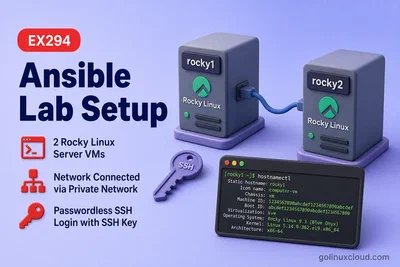
Build a two-node EX294 Ansible practice lab on Rocky Linux 10: hostnames, /etc/hosts, ansible user, SSH keys, passwordless sudo, and connectivity checks before installing ansible-core.
devops
Ansible Blocks, Rescue, Always, failed_when and changed_when Explained
Learn Ansible error handling with block, rescue, always, failed_when, changed_when, register checks, ignore_errors trade-offs, unreachable hosts, and meta: clear_host_errors.
devops
Ansible Tags Explained: Run and Skip Tasks in Playbooks
Learn Ansible tags to run or skip selected playbook tasks at runtime with --tags, --skip-tags, always, never, play and role tags, and safe partial runs.
devops
Ansible Loops Explained with loop, until, retries and delay
Learn Ansible loops with loop, loop_control, register results, when per item, until retries and delay, and when to use wait_for instead of looping.
devops
Ansible Handlers Explained: Restart Services Only When Tasks Change
Learn Ansible handlers with notify, service restarts, execution order, listen, flush_handlers, loops, roles, changed_when pitfalls, and common troubleshooting mistakes.
devops
Ansible Inventory Files: INI, YAML, Groups, and Variables
Learn how Ansible inventory files list hosts and groups in INI or YAML, where to place variables, how parent and child groups work, and how to verify with ansible-inventory and ping on Rocky Linux 10.
devops
How to Configure ansible.cfg for Ansible Projects on Linux
Configure ansible.cfg at the project root—search order, defaults, inventory path, remote_user, become, roles_path, and verification with ansible --version and ansible-config on Rocky Linux 10.
devops
How to Install Ansible on Rocky Linux 10
Install Ansible on Rocky Linux 10 using ansible-core, EPEL collection RPMs, pipx, or pip. Add ansible-navigator, Podman, verify versions, and run your first ping test.
devops
Create Ansible Roles and Install Roles from Ansible Galaxy
Create Ansible roles with ansible-galaxy init, customize tasks, defaults, handlers and templates, install Galaxy roles, and pin versions in requirements.yml.
devops
Ansible Vault Tutorial: Encrypt Variables, Files and Passwords
Learn Ansible Vault to encrypt files and variables with create, view, edit, encrypt, decrypt, rekey, vault IDs, password options, and secure group_vars and host_vars usage.
devops
RHCE EX294 Exam Objectives Explained with Ansible Study Plan
RHCE EX294 objectives explained as a practical Ansible study plan, with RHCSA task mapping, ansible-navigator focus, Rocky Linux lab guidance, and GoLinuxCloud course links.
devops
include_tasks vs import_tasks in Ansible: Difference and Examples
Compare Ansible import_tasks and include_tasks for static vs dynamic task loading, with conditions, loops, tags, apply, list-tasks behavior, and when to use each.