The whole reason kubectl delete myapp myapp-sample cleanly
removes the Deployment, the ReplicaSet, and three Pods is
Kubernetes owner references. They are tiny pieces of metadata,
easy to overlook, but they encode the entire owner-dependent
contract that controller-runtime's Owns(),
Kubernetes garbage collection,
and finalizer-driven cleanup
all rely on.
If you have already worked through the reconcile loop and Custom Resource Definitions, this is the next conceptual step in the Kubernetes operator pattern: the contract that decides what happens to a CR's dependents when the owner is deleted, the cluster restarts, or the operator crashes mid-reconcile.
We unpack that contract end-to-end: the difference between an
owner and a controller, the three deletion propagation
policies, the cross-namespace and cluster-scope rules, the
/finalizers RBAC that
makes blockOwnerDeletion actually work, and how to find orphans
when the contract goes wrong.
What Are Owner References in Kubernetes?
Owner references are metadata links stored in a resource's metadata.ownerReferences field that establish a parent-child relationship between Kubernetes objects.
They tell Kubernetes:
- Which resource owns another resource.
- Which resources should be automatically deleted when the owner is removed.
- Which dependent resource changes should trigger reconciliation of the owner.
- Which resources belong to the same ownership chain.
For example, a standard Kubernetes Deployment creates a ReplicaSet, and that ReplicaSet creates Pods:
Deployment
└── ReplicaSet
    └── Pod
Each child resource stores a reference to its parent in metadata.ownerReferences. Because of these ownership links, deleting the Deployment automatically removes the ReplicaSet and Pods as well.
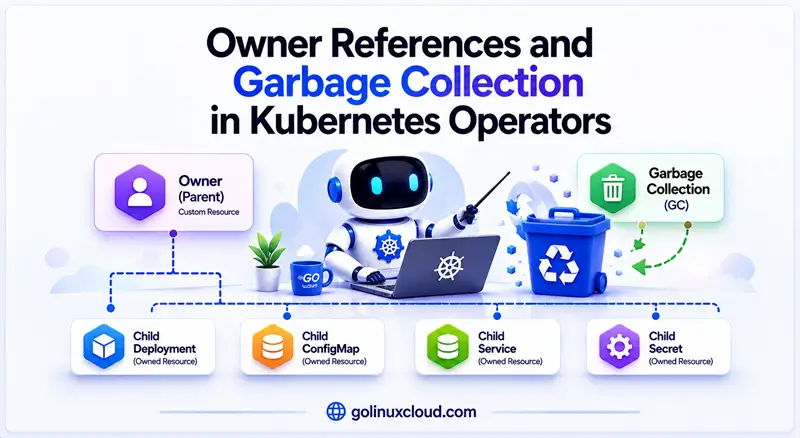
The same mechanism is heavily used by Kubernetes Operators. A Custom Resource (CR) typically owns the Deployments, Services, ConfigMaps, Secrets, Jobs, and StatefulSets that the operator creates:
MyApp (Custom Resource)
├── Deployment
├── Service
├── ConfigMap
└── Secret
When the CR is deleted, Kubernetes Garbage Collection (GC) follows those owner references and automatically removes the dependent resources.
Owner references are also what make controller-runtime's Owns() watches work. When a dependent resource changes, controller-runtime can trace the ownership chain back to the owning Custom Resource and enqueue it for reconciliation.
In short, owner references form the ownership contract between Kubernetes resources. They power cascade deletion, garbage collection, controller-runtime watches, and much of the automation that Operators rely on.
Owner References Explained in Plain Terms
You already use owner references every day in Kubernetes, even if you never look at the YAML.
Consider a Deployment:
Deployment
└── ReplicaSet
    └── Pod
The Deployment owns the ReplicaSet.
The ReplicaSet owns the Pod.
When you delete the Deployment, Kubernetes automatically removes the ReplicaSet and Pods.
That automatic cleanup happens because each child resource stores a pointer back to its owner in metadata.ownerReferences.
The Kubernetes garbage collector follows those ownership links and performs cascade deletion.
Anatomy of an owner reference
When controllerutil.SetControllerReference finishes, this is what
it has written onto the dependent's metadata:
metadata:
  ownerReferences:
  - apiVersion: apps.example.com/v1alpha1
    kind: MyApp
    name: myapp-sample
    uid: a3c5e8f0-1234-5678-abcd-ef0123456789
    controller: true
    blockOwnerDeletion: true
Five fields, each with a job:
| Field | Purpose |
|---|---|
apiVersion + kind |
Identifies the kind of owner — <group>/<version>/Kind |
name |
The owner's metadata.name |
uid |
The owner's metadata.uid — this is the unique identifier; name alone is not enough because names can be reused after delete + create |
controller: true |
"This is my primary controller" — Owns() watches require it |
blockOwnerDeletion: true |
"Do not let the owner disappear until I am cleaned up" |
The uid is the field that makes orphan detection possible. If
MyApp/myapp-sample is deleted and a fresh one is created with
the same name, the new CR has a different uid — dependents that
still reference the old uid are now orphans, and the new CR's
Owns() watches will not enqueue for them.
SetControllerReference vs SetOwnerReference
In every reconciler that creates dependent resources, the line you
will type ninety-nine times out of a hundred is
controllerutil.SetControllerReference. The canonical pattern inside a
multi-resource reconciler is one
CreateOrUpdate per dependent, each one mutating its desired spec
and re-asserting the owner reference:
deploy := &appsv1.Deployment{ObjectMeta: metav1.ObjectMeta{
    Name: app.Name, Namespace: app.Namespace,
}}
op, err := controllerutil.CreateOrUpdate(ctx, r.Client, deploy, func() error {
    deploy.Spec = r.deploymentSpec(&app)
    return controllerutil.SetControllerReference(&app, deploy, r.Scheme)
})
That single SetControllerReference call:
- Adds
apptodeploy.metadata.ownerReferences. - Sets
controller: trueandblockOwnerDeletion: trueon that entry. - Enables
Owns(&appsv1.Deployment{})watches to enqueueReconcile(app)when the Deployment changes. - Enables Kubernetes garbage collection to cascade-delete the Deployment when the CR is deleted.
If you forget that one line, three things break silently — and most operator authors discover it only when a production cluster ends up with hundreds of orphaned Deployments.
Controller-runtime exposes two helpers; they are not interchangeable:
controllerutil.SetControllerReference(owner, dependent, scheme)
controllerutil.SetOwnerReference(owner, dependent, scheme)| Helper | Adds reference? | Sets controller: true? |
Sets blockOwnerDeletion: true? |
|---|---|---|---|
SetControllerReference |
Yes | Yes | Yes |
SetOwnerReference |
Yes | No | No |
When to use which:
SetControllerReference: the canonical owner-dependent link between your CR and a workload it creates. Use this for the primary dependent (the Deployment, StatefulSet, Job). It powersOwns()watches and cascade GC.SetOwnerReference: when an object has multiple owners but only one of them is the controller. Example: a ConfigMap shared by several CRs — set one CR ascontrollerand the others as plain owners, so the ConfigMap gets cascade-deleted only when all owners are gone (with Foreground policy) or by the controller owner specifically.
A dependent can have many owners but only one controller
owner. The API server enforces this — adding a second
controller: true entry returns an error.
How deletion propagates
When kubectl delete <owner> runs, Kubernetes has to decide what
happens to the dependents. The propagation policy makes that
choice, and blockOwnerDeletion plus the cross-namespace rule
together decide which dependents the policy applies to.
Background — the default
kubectl delete myapp myapp-sample
# explicit form:
kubectl delete myapp myapp-sample --cascade=background
Behaviour:
- The owner is deleted from etcd immediately.
- The garbage collector finds every dependent
(
ownerReferences[*].uidequals the deleted owner's uid) and asynchronously deletes them. - Dependents may still exist briefly after the owner is gone.
Pros: fast user response. Cons: a brief window where dependents exist without an owner — usually fine because nothing is watching them.
Foreground — synchronous cleanup
kubectl delete myapp myapp-sample --cascade=foregroundBehaviour:
- The owner gets a
deletionTimestampand the specialforegroundDeletionfinalizer. - The garbage collector deletes every dependent whose owner
reference has
blockOwnerDeletion: true. - Once all blocking dependents are gone, the
foregroundDeletionfinalizer is removed, and the owner is finally deleted from etcd.
Pros: when the kubectl delete call returns, everything is gone.
Useful in tests and in user-facing scripts that need a synchronous
"all clear" signal.
Cons: slower; if a dependent's deletion hangs (its own finalizer is stuck), the owner gets stuck too.
Orphan — keep the dependents
kubectl delete myapp myapp-sample --cascade=orphanBehaviour:
- The owner is deleted.
- The garbage collector removes the owner reference from each dependent but does not delete the dependents.
- Each former dependent now has no owner — it survives until deleted by name.
Use case: emergency migration. You want to move dependents to a
new owner without their workloads restarting. Delete with
--cascade=orphan, recreate the CR with the same name, and
manually re-attach owner references with kubectl patch.
The term
orphanis part of the Kubernetes API (--cascade=orphan,DeletePropagationOrphan), so it shows up wherever the API surface does — including the next two sections, where we go hunting for them.
blockOwnerDeletion — what makes Foreground wait
blockOwnerDeletion: true is the field that turns Foreground
deletion into a real precondition:
- The garbage collector treats each blocking dependent as a
precondition on the owner's
foregroundDeletionfinalizer. - The owner's
foregroundDeletionfinalizer stays in place until every blocking dependent has been deleted.
If blockOwnerDeletion: false on a dependent, that dependent does
not block the owner's foreground deletion. The owner can be
deleted even while that dependent still exists.
SetControllerReference sets blockOwnerDeletion: true by default
because for the controller-owner relationship that is what you
want: the owner's deletion shouldn't complete until I, the primary
dependent, am gone. Plain SetOwnerReference does not set it
because secondary owners don't typically block.
RBAC implication
To set blockOwnerDeletion: true on a dependent, the operator's
ServiceAccount needs the update verb on the owner kind's
finalizers subresource. This is a non-obvious permission, and
it lives in
the operator RBAC checklist:
- apiGroups: ["apps.example.com"]
  resources: ["myapps/finalizers"]
  verbs: ["update"]
The +kubebuilder:rbac:groups=apps.example.com,resources=myapps/finalizers,verbs=update
marker generates it. Without that permission,
SetControllerReference silently writes the reference without
blockOwnerDeletion, which means Foreground deletion stops
blocking on this dependent. Easy to miss; even easier to ship to
production.
Setting the policy from Go
import (
    metav1 "k8s.io/apimachinery/pkg/apis/meta/v1"
    "sigs.k8s.io/controller-runtime/pkg/client"
)

policy := metav1.DeletePropagationForeground
if err := r.Delete(ctx, &app, &client.DeleteOptions{
    PropagationPolicy: &policy,
}); err != nil {
    return err
}
Most operator code never explicitly sets a propagation policy — it deletes its own CRs and relies on background cleanup. The policy matters when you're writing test harnesses, custom tooling, or operator-on-operator chains.
The cross-namespace and cluster-scope rules
Kubernetes enforces a strict scoping rule on owner references:
A namespaced dependent must be in the same namespace as its namespaced owner.
If you try to create a Pod in namespace-a with an
ownerReference pointing at a Deployment in namespace-b, the
API server silently drops the reference. Not an error, not a
warning — the reference is just gone, the dependent has no
owner, and GC will never cascade-delete it.
What you can do:
| Owner scope | Dependent scope | Allowed? |
|---|---|---|
| Namespaced (same namespace) | Namespaced | Yes |
| Cluster-scoped | Namespaced | Yes |
| Cluster-scoped | Cluster-scoped | Yes |
| Namespaced | Cluster-scoped | No — rejected |
| Namespaced (other namespace) | Namespaced | No — silently dropped |
Operators that need to manage resources across namespaces have two options:
- Use a cluster-scoped CR. Then it can own resources in any namespace.
- Use labels + finalizers instead of owner references. Tag
each dependent with
<group>/<cr-uid>: ..., list-and-cleanup on owner delete via finalizer. More work, but no scope restriction.
Finding orphans
A production cluster always accumulates some orphans:
- An operator was uninstalled before its CRs were deleted.
- A dependent resource was created with a stale
uidpointing at a long-deleted CR. - A cross-namespace owner reference was silently dropped.
To enumerate them:
# Every resource managed by this operator
kubectl get deployment,service,configmap,secret -A \
  -l app.kubernetes.io/managed-by=myapp-operator

# Group by owner uid to find orphans
kubectl get deploy -A -o json | jq '
  .items[] | select(.metadata.labels."app.kubernetes.io/managed-by" == "myapp-operator") |
  {name: .metadata.name, ns: .metadata.namespace,
   owners: [.metadata.ownerReferences[]? | {kind, name, uid}]}'
Cross-check each owners[].uid against the current CRs:
kubectl get myapp -A -o jsonpath='{range .items[*]}{.metadata.uid}{"\n"}{end}' > current-uids.txtAny Deployment whose owner uid is not in current-uids.txt is an
orphan. The cleanup tool is your label query:
kubectl delete deployment -A -l app.kubernetes.io/managed-by=myapp-operator \
  --field-selector=status.replicas=0   # be careful, narrow scope first
The same idea — label every dependent the operator creates with
app.kubernetes.io/managed-by=<operator-name> plus the parent CR's
name and uid — is also what lets a
multi-resource reconciler detect
drift on a per-dependent
basis without trawling owner references in every reconcile.
When owner references are not enough
Owner references are great for in-Kubernetes dependents. They are useless for:
- External resources: cloud disks, DNS records, IAM roles, items in another cluster. GC cannot delete what it cannot see.
- Cross-namespace dependents: silently dropped owner reference, no GC.
- Things the controller wants to clean up itself: ordered shutdown sequences, drain operations, billing reconciliation.
For all of those, use a finalizer. Owner references and finalizers are complementary:
| Cleanup target | Mechanism |
|---|---|
| Same-namespace dependent resources | Owner references (free with SetControllerReference) |
| External / cross-namespace / billing | Finalizer (explicit cleanup code) |
The general rule: owner references handle Kubernetes deletion;
finalizers handle everything else. Most production operators have
both, and they slot into
the reconcile loop
through the same deletionTimestamp check.
Verifying the ownership chain end-to-end
Once the operator is deployed and a sample CR is applied, trace the chain top-down to confirm every link is intact:
# Pod -> ReplicaSet
kubectl get pod -l app=myapp-sample -o jsonpath='{range .items[0].metadata.ownerReferences[*]}{.kind}/{.name}{"\n"}{end}'
# ReplicaSet/myapp-sample-7c9b-xyz9

# ReplicaSet -> Deployment
kubectl get rs myapp-sample-7c9b-xyz9 -o jsonpath='{range .metadata.ownerReferences[*]}{.kind}/{.name}{"\n"}{end}'
# Deployment/myapp-sample

# Deployment -> MyApp CR
kubectl get deploy myapp-sample -o jsonpath='{range .metadata.ownerReferences[*]}{.kind}/{.name}{"\n"}{end}'
# MyApp/myapp-sample
That chain is exactly what makes kubectl delete myapp myapp-sample cascade through three levels. If any link is
missing, cascade stops there — leaving everything below as
orphans.
Diagnosing a missing controller: true
Run:
kubectl get deploy myapp-sample -o yaml | grep -A6 ownerReferencesIf controller: true is missing:
ownerReferences:
- apiVersion: apps.example.com/v1alpha1
  kind: MyApp
  name: myapp-sample
  uid: ...
  # controller: true        ← MISSING
  # blockOwnerDeletion: true ← MISSING
Two consequences:
Owns(&appsv1.Deployment{})watches in your operator do not enqueue reconciles on Deployment changes — they filter bycontroller: true.- Foreground deletion does not wait for this Deployment.
Cause: you used SetOwnerReference instead of
SetControllerReference. Fix: switch to SetControllerReference,
or call SetOwnerReference first as a plain owner and then
SetControllerReference to upgrade the entry to a controller
reference.
Common pitfalls
1. Using SetOwnerReference instead of SetControllerReference
The Deployment is owned but not controlled. Owns(&Deployment{})
watches never fire. Easy to miss. Fix: use
SetControllerReference for the primary dependent.
2. Missing the /finalizers RBAC
blockOwnerDeletion: true silently disappears, Foreground
deletion doesn't block, and you only notice when test cleanup
returns before child workloads have actually finished. Fix: add
the +kubebuilder:rbac marker
for the CR kind's finalizers subresource.
3. Cross-namespace owner reference
You wired the operator to create a Pod in another namespace; the reference was dropped; Pods become orphans on CR delete. Fix: keep dependents in the CR's namespace, use a cluster-scoped CRD, or manage cleanup via finalizer.
4. Recreating a CR with the same name
The dependents from the previous CR still carry the old uid.
The new CR has a new uid. Owns() does not enqueue, and the new
reconciler thinks no dependents exist. Fix: clean up orphans
first, or design the operator to detect and adopt
previously-owned resources by label.
5. Trusting cascade delete for external resources
Delete the CR, the Deployment is cascade-deleted — but the cloud disk the Deployment was using is orphaned. Fix: add a finalizer that unmounts and deletes the disk before letting the cascade run.
Frequently Asked Questions
1. What is an owner reference in Kubernetes?
ownerReferences entry on metadata is a typed pointer from a dependent object to its owner. It tells the Kubernetes garbage collector: "if the owner is deleted, cascade-delete me." It also lets controller-runtime's Owns() watch enqueue the owner for reconciliation whenever the dependent changes.2. What is the difference between SetControllerReference and SetOwnerReference?
ownerReferences entry. SetControllerReference additionally sets controller: true and blockOwnerDeletion: true - the dependent marks the owner as its primary controller, and Owns() watches will enqueue reconcile only for entries with controller: true. Each dependent can have many owners but only ONE controller owner. Use SetControllerReference for the canonical owner-dependent link where you want Owns() to fire; SetOwnerReference for secondary owners.3. What are the three deletion propagation policies?
Background (default for most kinds) - the owner is deleted immediately, dependents are cascade-deleted asynchronously. Foreground - the owner stays visible until ALL dependents are deleted (deletionTimestamp is set first). Orphan - owner deleted, dependents kept (the ownerReference is removed from each dependent). Pick with kubectl delete --cascade=... or client.PropagationPolicy(metav1.DeletePropagationForeground).4. What does blockOwnerDeletion do?
true on a dependent's ownerReferences[*].blockOwnerDeletion, the owner cannot be deleted (with the default Background policy) until the dependent is gone. Most operators set it via SetControllerReference automatically. It prevents the owner from disappearing while the controller still has ependent cleanup work pending.5. Why can owner references not cross namespaces?
6. Can a namespaced resource own a cluster-scoped resource?
7. How do I find orphaned resources after an operator restart?
ownerReferences pointing at objects that no longer exist: kubectl get pods -A -o jsonpath="{range .items[?(@.metadata.ownerReferences[*].uid=='\'$old_uid'\')]}...". (2) Label every operator-managed resource with app.kubernetes.io/managed-by=<operator-name> and reconcile by listing those labels - any unowned resource is an orphan. Pattern 2 is much more practical.8. When should I rely on GC vs use a finalizer?
Summary
Owner references encode the contract every other part of the
operator pattern relies on: Owns() watches enqueue the owner
when a dependent changes, garbage collection cascade-deletes
dependents when the owner is deleted, and blockOwnerDeletion
makes Foreground deletion behave synchronously. The single most
important line is controllerutil.SetControllerReference inside
every CreateOrUpdate block — get that right and 90% of the
machinery is automatic.
The other 10% — external resources, cross-namespace cleanup, ordered shutdown — needs finalizers. Used together, the two mechanisms cover every cleanup scenario a production operator will see, and they slot cleanly into the same level-triggered reconcile loop the rest of the operator already runs on.
Further reading
the complement to GC for everything Kubernetes cannot delete on
its own.
the /finalizers subresource RBAC that makes
blockOwnerDeletion work.
the per-child builder pattern that wires
SetControllerReference into every dependent the operator
creates.
what to do when a dependent has drifted from desired state but
is still owned correctly.
the level-triggered control loop that processes
deletionTimestamp and runs the cascade in the first place.
the schema for the CR sitting at the root of the ownership tree.
where the Owns() watch, the cache, and the workqueue fit
together.
- External: Kubernetes owner references docs,
garbage collection reference,
controllerutilpackage reference.