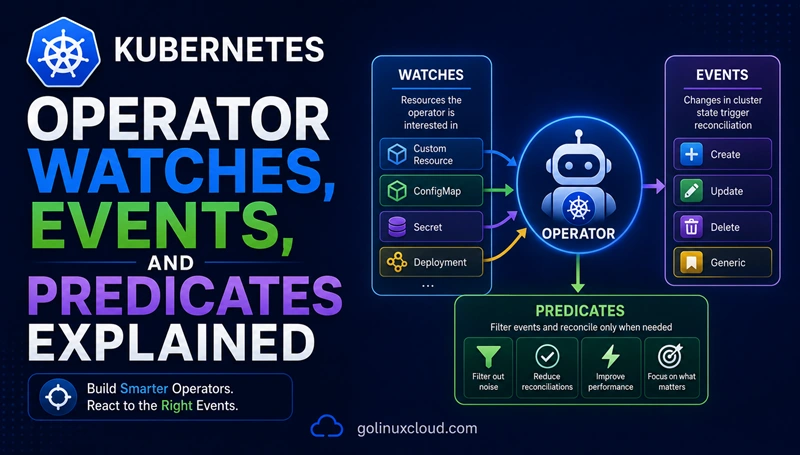
Watches, events, and predicates are the three pieces that decide which
changes wake your Operator's Reconcile() function. Get them right and your
operator reacts in milliseconds to every meaningful change while ignoring
noise. Get them wrong and you ship one of the two classic Operator failure
modes — a hot reconcile loop that pegs CPU, or a silent operator that misses
cleanups and drift.
This guide covers every piece end-to-end: the four event types, the
difference between Owns and Watches, the catalogue of built-in
predicates, how to write a custom predicate.Funcs, and the pitfalls that
cost real production incidents.
If you have not yet read the controller-runtime architecture, that article puts these three pieces in their wider context (Manager, Cache, Workqueue). This one zooms in on the filtering part.
TL;DR — watches, events & predicates in 60 seconds
Every controller in your Operator is wired to its workqueue through three collaborators:
- Source - a
source.Kind(mgr.GetCache(), &SomeKind{})that reads watch deltas from the shared cache. - EventHandler - turns one
Create/Update/Delete/Genericevent into zero or moreRequest{namespace/name}items. - Predicate - a four-function filter applied before the handler runs; return false and the event is dropped on the floor.
You build the wiring with three Builder verbs and one optional filter:
ctrl.NewControllerManagedBy(mgr).
    For(&v1alpha1.MyKind{}).                          // primary watch
    Owns(&corev1.Pod{}).                              // child via ownerRef
    Watches(                                          // arbitrary input
        &corev1.ConfigMap{},
        handler.EnqueueRequestsFromMapFunc(r.mapCMtoMyKind),
    ).
    WithEventFilter(predicate.GenerationChangedPredicate{}).
    Complete(r)
This is exactly the block you see inside every controller's
SetupWithManager() — the function kubebuilder and Operator SDK
scaffold to register watches against the Manager.
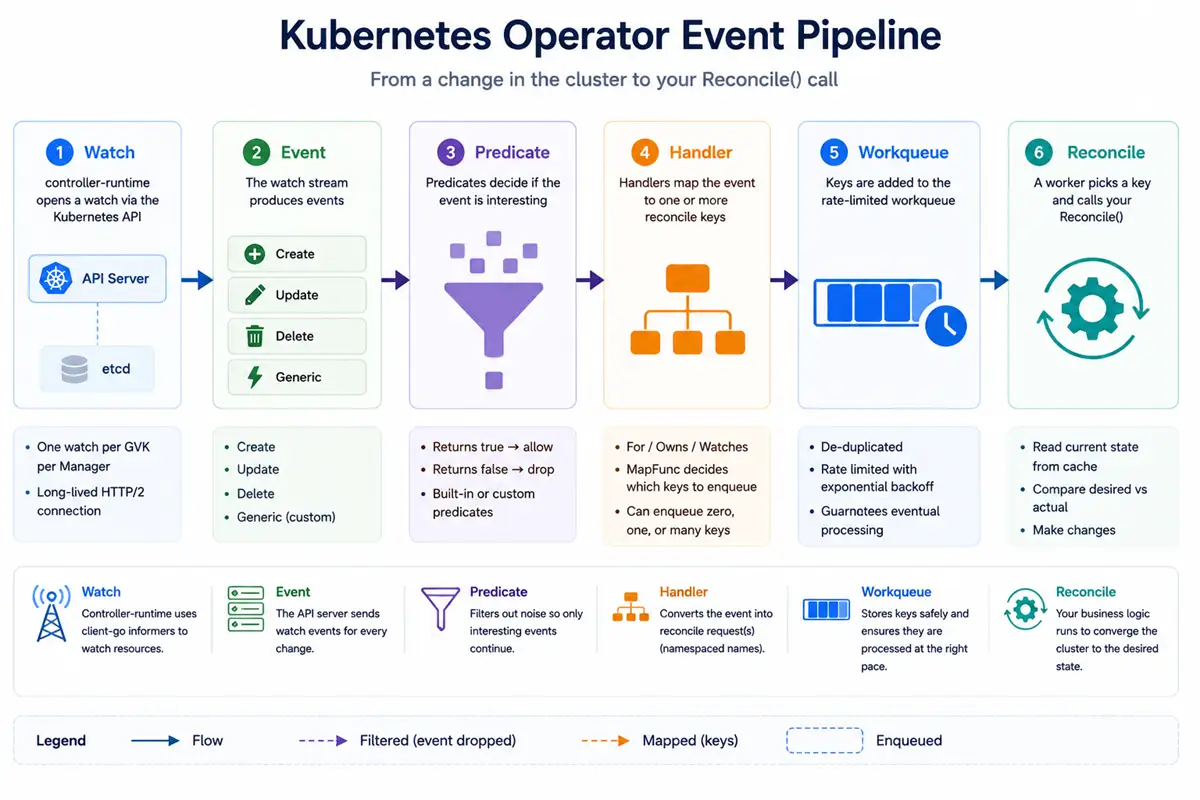
Every change in the cluster follows the same path:
Watch → Event → Predicate → Handler → Workqueue → Reconcile()Predicates decide whether an event is interesting. Handlers decide which reconcile keys should be queued. The workqueue then schedules the actual reconciliation.
A quick analogy: your email inbox with rules
Picture your work email inbox before and after you set up filters.
- The mailbox itself is your watch. Every email lands in it. You cannot stop the flow.
- Each email arriving is an event — there are four flavours: a new email, a reply on an existing thread, a deleted email, and a "calendar ping" your phone synthesised because someone declined your meeting (see ping command).
- The filter rules are your predicates: "if the subject contains 'PR review' AND it is from the team, mark it important. Otherwise leave it alone."
- The action is your handler: archive, star, forward, ping you on Slack.
A bad filter (predicate) wakes you for every newsletter (hot loop). A missing filter rule for "missed delete" lets a deleted invitation linger in your calendar (silent operator). The skill in writing a controller is the same skill as writing email filters: react to the changes that matter, ignore the noise, and make sure the delete and unsubscribe events get just as much attention as the create events.
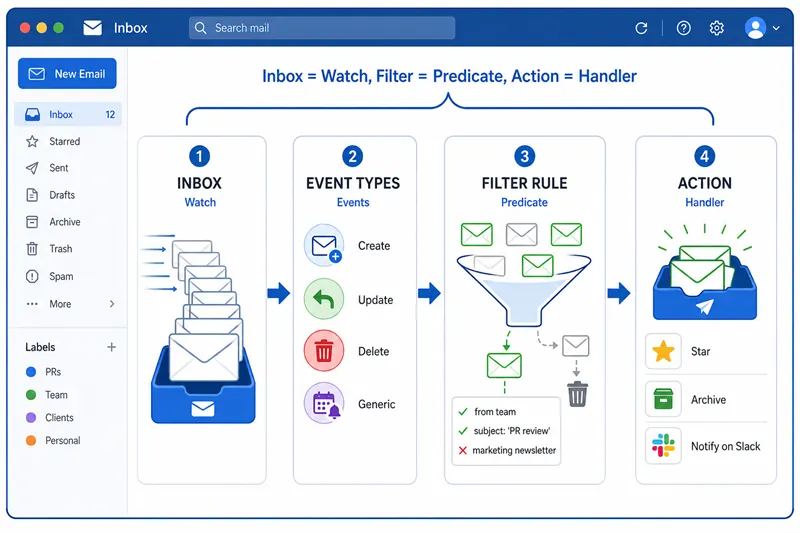
The rest of this article maps that picture onto the controller-runtime API.
Why watches, events, and predicates matter
Three reasons it is worth getting this layer right rather than copy-pasting
the default kubebuilder scaffold and hoping for the best:
1. They decide every reconcile your operator ever runs
A controller never reconciles on its own — something has to put a key in
the workqueue. That "something" is always a watch + event + predicate +
handler chain. Get the wiring wrong and one of two failure modes ships:
either you miss legitimate changes (silent operator, broken drift
correction) or you fire on every status write you make (hot reconcile
loop, etcd write rate climbs, CPU pegs). Both are common production
incidents and both live in the 30 lines of SetupWithManager.
2. They are the only place to enforce O(1) cluster-wide cost
A naive operator on a 5,000-Pod cluster wakes up for every Pod
modification — millions of reconciles per day. The two levers that make
that cost manageable both live in this layer:
cache-layer filtering (cache.Options.ByObject with namespace allow-lists or label
selectors) keeps the informer from ever loading those Pods, and
field indexers (mgr.GetFieldIndexer().IndexField(...)) make
cross-reference lookups O(1) instead of O(N). Both are invisible to your
business logic and both are what differentiate a production operator from
a toy one.
3. They power the multi-resource reconcile pattern
Owns() is what wakes the parent CR when a child Pod crashes or a child
ConfigMap is hand-edited. Without it, the operator only reconciles on CR
.spec changes and the 10-hour resync — and the entire premise of
level-triggered drift correction collapses. The patterns in this article
are the contract every multi-child operator depends on.
The four event types
controller-runtime delivers exactly four event types to your predicates and
handlers, defined in
sigs.k8s.io/controller-runtime/pkg/event.
They map one-to-one onto the incremental change-notification feed the
Kubernetes API server itself emits — see the
API concepts documentation
for the lower-level WatchEvent shape.
| Event | When it fires | Caveat |
|---|---|---|
CreateEvent |
The object appeared in the cache - either created via the API or seen for the first time on the initial list. | Every Operator gets a flood of Create events on startup. Make Reconcile() idempotent. |
UpdateEvent |
An existing object's resource version changed. | Carries both ObjectOld and ObjectNew, so predicates can diff. |
DeleteEvent |
The object left the cache - because it was really deleted, or because a label/namespace selector stopped matching. | If you need cleanup on real deletion, use a finalizer; do not rely on DeleteEvent alone. |
GenericEvent |
A synthetic event you fire yourself via a source.Channel. |
Useful for bridging webhooks, periodic pollers, or external systems into your reconciler. |
The shape of predicate.Funcs mirrors this exactly:
type Funcs struct {
    CreateFunc  func(event.CreateEvent) bool
    UpdateFunc  func(event.UpdateEvent) bool
    DeleteFunc  func(event.DeleteEvent) bool
    GenericFunc func(event.GenericEvent) bool
}
Trap to remember. When a
Funcsfield is leftnil, the predicate framework returns true by default in current versions, but historically that was not always the case and the rule has bitten people across upgrades. Make the behaviour explicit - always set all four fields. Future you will thank present you.
For, Owns, Watches - three verbs, three queues
The Builder DSL has exactly three watch verbs, each backed by a different event-handler default:
| Builder verb | Watches | Default handler | Best use |
|---|---|---|---|
For |
The primary custom resource | EnqueueRequestForObject |
The object this controller reconciles |
Owns |
Child objects with owner references | EnqueueRequestForOwner |
Pods, Services, Deployments, or Jobs created by the CR |
Watches |
Any object type you choose | Custom handler | ConfigMaps, Secrets, cluster-scoped resources, or external dependency signals |
For(&v1.MyKind{}) - the primary watch
There is always exactly one For per controller. It registers a watch on your
custom resource, attaches the default handler.EnqueueRequestForObject, and
the reconcile key becomes Request{ObjectMeta.namespace, ObjectMeta.name}.
Owns(&corev1.Pod{}) - child resource via owner-reference
Owns is sugar for "watch Pods, and for every Pod event, walk
metadata.ownerReferences looking for an owner of MyKind; if you find one,
enqueue its key". The default handler is
handler.EnqueueRequestForOwner:
handler.EnqueueRequestForOwner(
    mgr.GetScheme(),
    mgr.GetRESTMapper(),
    &v1.MyKind{},
    handler.OnlyControllerOwner(),
)
For Owns to actually work, you must set the owner reference on the child
at creation time:
if err := controllerutil.SetControllerReference(&parent, &pod, r.Scheme); err != nil {
    return ctrl.Result{}, err
}
Forgetting this is one of the most common operator bugs. The reconciler
creates a child, the child is never linked back to the parent, and when
the child changes the parent never wakes up. Symptom:
drift correction is broken;
root cause: SetControllerReference was missed. See
owner references and garbage collection
for controller: true vs blockOwnerDeletion and the cascade-delete
semantics that follow from Owns. For the full multi-child reconcile
pattern that Owns enables, see
multi-resource reconciliation.
Watches(obj, handler) - the general escape hatch
Watches lets you map any resource's events to any set of reconcile
keys. The classic use case is a ConfigMap referenced by name in your custom
resource's .spec:
.Watches(
    &corev1.ConfigMap{},
    handler.EnqueueRequestsFromMapFunc(r.findMyKindsByConfigMap),
)func (r *MyReconciler) findMyKindsByConfigMap(ctx context.Context, obj client.Object) []reconcile.Request {
cm, ok := obj.(*corev1.ConfigMap)
if !ok {
return nil
}
var list v1alpha1.MyKindList
if err := r.List(ctx, &list, client.InNamespace(cm.Namespace),
client.MatchingFields{"spec.configMapRef": cm.Name},
); err != nil {
return nil
}
reqs := make([]reconcile.Request, 0, len(list.Items))
for _, mk := range list.Items {
reqs = append(reqs, reconcile.Request{NamespacedName: client.ObjectKey{
Namespace: mk.Namespace, Name: mk.Name,
}})
}
return reqs
}Field indexers — making the MapFunc lookup O(1)
The client.MatchingFields{"spec.configMapRef": cm.Name} lookup above
needs the controller-runtime cache to index spec.configMapRef — without
that, the List becomes a full scan of every cached CR on every ConfigMap
event. The fix is a one-shot field indexer registration in
SetupWithManager:
mgr.GetFieldIndexer().IndexField(ctx, &v1alpha1.MyKind{}, "spec.configMapRef",
    func(rawObj client.Object) []string {
        mk := rawObj.(*v1alpha1.MyKind)
        return []string{mk.Spec.ConfigMapRef}
    })
Two rules of thumb for controller-runtime field indexers:
- Register an indexer for every field you
MatchingFields-query. Without it, theWatchesMapFunc above does an O(N) walk on every ConfigMap update — and your operator quickly becomes the slowest thing in the cluster. - Index the raw field path, not a derived value. Index
spec.configMapRefdirectly, not a string you compute from it; this keeps the index updates cheap and avoids subtle staleness when the derivation changes.
Built-in predicates you will actually use
The predicate package ships a small catalogue of ready-made filters. The three you will reach for in 90% of Operators:
GenerationChangedPredicate{} - the hot-loop killer
Fires on Update events only when metadata.generation differs between old
and new objects. The API server bumps generation only on .spec (or
sometimes annotation) changes - never on .status. Apply this anywhere your
reconciler writes status:
ctrl.NewControllerManagedBy(mgr).
    For(&v1alpha1.MyKind{}).
    WithEventFilter(predicate.GenerationChangedPredicate{}).
    Complete(r)
Without it, every r.Status().Update(...) you make triggers a fresh watch
event, which triggers another reconcile, which writes status, which... you
see where this is going. See
the reconcile loop explained for
the full hot-loop autopsy, and
Status subresource and Conditions for
the complementary equality.Semantic.DeepEqual guard you should pair with
this predicate when writing .status.
ResourceVersionChangedPredicate{} - fires on every server-side update
The opposite of GenerationChangedPredicate. Use it when you genuinely need
to react to every change - including .status updates from peer controllers
and managedFields updates from
Server-Side Apply. Most Operators
do not want this.
LabelChangedPredicate{} and AnnotationChangedPredicate{}
Fire on Update only when labels or annotations differ. Useful when you
react to user-managed tags - for instance, a backup operator that pauses
backups when a Pod has acme.io/backup: paused.
Combining predicates
The predicate package ships And and Or combinators:
predicate.And(
    predicate.GenerationChangedPredicate{},
    predicate.LabelChangedPredicate{},
)
You can also scope a predicate to a specific Builder verb instead of applying it controller-wide:
labelPred, err := predicate.LabelSelectorPredicate(metav1.LabelSelector{
    MatchLabels: map[string]string{"app": "myapp"},
})
if err != nil {
    return err
}

.Watches(
    &corev1.ConfigMap{},
    handler.EnqueueRequestsFromMapFunc(r.mapCM),
    builder.WithPredicates(labelPred),
)
This is the right tool when the primary watch wants
GenerationChangedPredicate but the secondary watch needs a different filter -
otherwise the controller-wide WithEventFilter would over-filter ConfigMap
events.
Writing a custom predicate.Funcs
The most maintainable custom predicates set all four fields explicitly, even when three of them just return true:
import "sigs.k8s.io/controller-runtime/pkg/event"

productionOnly := predicate.Funcs{
    CreateFunc: func(e event.CreateEvent) bool {
        return e.Object.GetLabels()["tier"] == "production"
    },
    UpdateFunc: func(e event.UpdateEvent) bool {
        oldTier := e.ObjectOld.GetLabels()["tier"]
        newTier := e.ObjectNew.GetLabels()["tier"]
        return oldTier == "production" || newTier == "production"
    },
    DeleteFunc: func(e event.DeleteEvent) bool {
        return e.Object.GetLabels()["tier"] == "production"
    },
    GenericFunc: func(e event.GenericEvent) bool {
        return e.Object.GetLabels()["tier"] == "production"
    },
}
Two patterns worth noting:
- The
UpdateFuncchecks both old and new labels - so removing thetier=productionlabel still fires one final reconcile, which is usually what you want for cleanup. - The
DeleteFuncmatches on the cached object - which may be slightly stale, but the only object the framework has when the watch reports a deletion.
Filtering at the cache layer
The cheapest filter is the one the informer never receives. controller-runtime
lets you scope the cache itself via cache.Options.ByObject:
mgr, err := ctrl.NewManager(ctrl.GetConfigOrDie(), ctrl.Options{
    Scheme: scheme,
    Cache: cache.Options{
        ByObject: map[client.Object]cache.ByObject{
            &corev1.Pod{}: {
                Label: labels.SelectorFromSet(labels.Set{"app": "myapp"}),
            },
        },
    },
})
This is dramatically more efficient than predicate-level filtering on a busy
cluster - your operator's cache never holds the millions of Pods it does not
care about. The catch: the SharedInformer treats "object stopped matching
the selector" the same as "object was deleted" and emits a DeleteEvent.
If your reconciler runs cleanup on DeleteEvent, that cleanup may run when
the object is alive and well, just relabeled. Use a finalizer if you must
run cleanup only on real deletion.
The controller-runtime cache documentation
covers the full ByObject surface, including namespace allow-lists (a
common knob for
multi-tenant operators) and field
selectors.
Predicate vs cache-layer filtering — which one when?
The article so far has shown two places you can filter:
cache.Options.ByObject (informer-level, before the event ever exists)
and WithEventFilter / builder.WithPredicates (workqueue-level,
after the event but before reconcile). They are not interchangeable. A
quick decision matrix:
| You want to… | Filter at the | Why |
|---|---|---|
| Drop status-only updates on the primary CR | Predicate (GenerationChangedPredicate) |
The cache still needs the latest object so that r.Get() returns it |
Cache only Pods labelled app=myapp |
Cache (cache.Options.ByObject) |
Avoid loading millions of unrelated Pods into memory |
| Watch ConfigMaps but only react to label changes | Predicate (LabelChangedPredicate) |
Cache still needs the CMs so r.Get() and MapFunc lookups work |
| Restrict the operator to one or two namespaces | Cache (cache.Options.DefaultNamespaces) |
Far cheaper than per-event filtering, and resolves RBAC scope at the same time |
| React only when an annotation changes | Predicate (AnnotationChangedPredicate) |
Selective — the cache still needs every object |
Skip ConfigMaps in kube-system |
Cache (namespace deny-list) | Stops the noise at the source; predicates would still pay the watch cost |
Rule of thumb: filter as early as possible, but never trade away the
ability to r.Get() an object you genuinely need to read. Cache
filtering is the cheapest, predicate filtering is the most flexible, and
they compose — use both in the same SetupWithManager when the situation
calls for it.
The five pitfalls that ship to production
In rough order of how often they cause incidents:
-
Custom
predicate.Funcswith an over-strictDeleteFunc. The predicate returns false for a deleted object that still needs cleanup, so the handler never sees it. Fix: make delete predicates deliberately permissive, and always test label-removal and deletion paths. -
No
GenerationChangedPredicateon the primary watch. EveryStatus().Update()triggers another reconcile. Fix: apply the predicate, or skip status writes when the new status equals the cached one. -
OwnswithoutSetControllerReference. The child is created but never linked back to the parent. Fix: callcontrollerutil.SetControllerReference(&parent, &child, r.Scheme)before everyr.Create(...)of a child. -
Watcheswith aMapFuncthat does an un-indexedList. The secondary watch fires once per ConfigMap change, yourMapFuncdoes a full-cluster List, your operator gets quoted from the apiserver. Fix: register a field indexer so the lookup is O(1). -
Cache
Labelselector used for cleanup logic. "Object left the cache" is delivered asDeleteEventwhether the object was deleted or just relabeled. Fix: rely on finalizers for cleanup-on-real-deletion, not onDeleteEventalone.
Pitfall cheat sheet
| Symptom | Root cause | Fix |
|---|---|---|
| CPU pegs after a deploy, etcd write rate climbs | Pitfall 2 — no GenerationChangedPredicate on the primary watch |
WithEventFilter(predicate.GenerationChangedPredicate{}) + equality.Semantic.DeepEqual guard on Status().Update() |
| Editing a child Pod / Service does not wake the parent CR | Pitfall 3 — Owns() registered but SetControllerReference missed at creation |
Call controllerutil.SetControllerReference(&parent, &child, r.Scheme) inside every CreateOrUpdate mutate fn |
| Operator goes from 50 ms to 5 s per reconcile under load | Pitfall 4 — Watches MapFunc does un-indexed List() |
Register a field indexer for the MatchingFields field |
| Cleanup runs on a Pod that is actually alive (just relabeled) | Pitfall 5 — Label cache selector + DeleteEvent-driven cleanup |
Cache-filter the queries, not the cleanup decision; move cleanup behind a finalizer |
| Operator reacts to status writes from peer controllers in unexpected ways | Using ResourceVersionChangedPredicate when you meant GenerationChangedPredicate |
Pick the right predicate — ResourceVersionChanged fires on every server-side update |
Frequently Asked Questions
1. What are watches in a Kubernetes operator?
2. What are the event types in controller-runtime?
3. What is the difference between Owns and Watches in controller-runtime?
4. What is predicate.Funcs in Kubernetes?
5. What does GenerationChangedPredicate do?
6. Why is my operator missing Delete events?
7. Can I watch a resource and filter by namespace or label?
8. When should I register a field indexer in controller-runtime?
9. Should I filter events at the cache layer or in a predicate?
What's next?
With watches, events, and predicates handled, you have the full picture of how a controller observes the cluster. Natural next reads:
- The controller-runtime architecture — the wider picture (Manager, Cache, Workqueue) that this article zooms into.
- The Kubernetes reconcile loop explained —
what your
Reconcile()function is contractually expected to do once the workqueue hands it a key. - Status subresource and Conditions —
the companion to
GenerationChangedPredicate: how to write status without triggering the hot loop the predicate exists to absorb. - Multi-resource reconciliation — the
multi-child reconcile pattern that depends end-to-end on
Owns()and the cache filtering covered here. - Owner references and garbage collection —
the contract
Owns()requires you to honour at child-creation time, plus the cascade-delete semantics that follow. - Server-Side Apply (SSA) in operators —
the writer-side counterpart to the
managedFieldsupdates you saw inResourceVersionChangedPredicate. - Custom Resource Definitions explained — the schema that the watches in this article are watching.
- Finalizers in Kubernetes — the
AddFinalizer/RemoveFinalizerdance that pairs withDeleteEventto make deletion safe even under cache-filter relabel churn.
Looking for the bigger picture? The Kubernetes Operator tutorial sequences every article in this series in pedagogical order — this article sits in the controller-runtime internals chapter alongside the architecture, status, finalizers, and owner-references guides.